




Stanford researchers are developing a transformer-based Large Coordination Model that treats workplace activities as sequences of events, potentially helping organisations predict bottlenecks, improve collaboration and manage increasingly complex human-AI workflows.
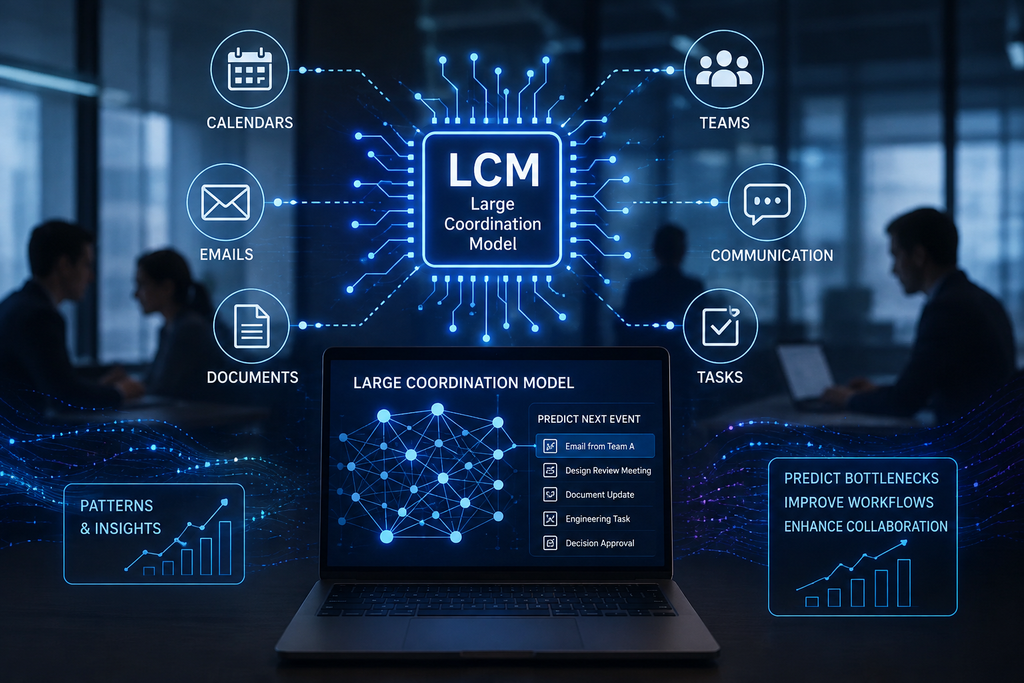
Stanford researchers are exploring how the transformer technology behind large language models (LLMs) could be adapted to understand and predict how people, teams and increasingly artificial intelligence (AI)-enabled systems coordinate their work. The proposed technology, called a Large Coordination Model (LCM), applies a concept similar to next-word prediction in LLMs. Instead of analysing words in sentences, however, the system would analyse sequences of workplace events and predict what is likely to happen next.
Researchers Yankai Wang and Amir Goldberg plan to train the model using anonymised organisational data from sources such as calendars, emails and shared documents. By processing these streams of workplace activity, the transformer-based system could identify recurring patterns that reveal the underlying “grammar” of coordinationhow people exchange information, make decisions and move work forward.
The project was selected from more than 200 academic proposals in Stanford’s AI for Organizations Grand Challenge, receiving a $100,000 award along with access to resources from Google DeepMind to develop the concept further. The technology could eventually give organisations a new predictive layer for managing complex operations. A Large Coordination Model might identify potential workflow bottlenecks before they affect performance, forecast how teams are likely to respond to changing workloads, or help companies understand where communication gaps are creating friction.
One particularly significant application could be the creation of a virtual representation of an organisation. Such a model could allow researchers and companies to simulate changes to workflows or organisational structures before implementing them in the real workplace. For electronics and technology-driven industries, where engineering, manufacturing, supply chains and product development increasingly depend on interconnected teams and digital systems, this predictive capability could become especially valuable. Understanding how information and tasks move between people, software platforms and AI agents could help reduce coordination delays in complex development environments.
The research also reflects a broader shift in workplace AI. Rather than simply automating individual tasks, emerging systems are beginning to address the coordination layer that connects those tasks. Researchers believe AI could help organisations move beyond rigid structures by identifying collaboration needs that conventional organisational charts may overlook. However, the researchers emphasise that the technology is still under development. If successful, the Large Coordination Model could provide a new computational framework for studying and eventually improving the increasingly complex coordination between humans, digital tools and AI agents.
