A new computing module brings AI, graphics, memory, and fast connections to industrial, medical, machine vision, and digital signage systems.
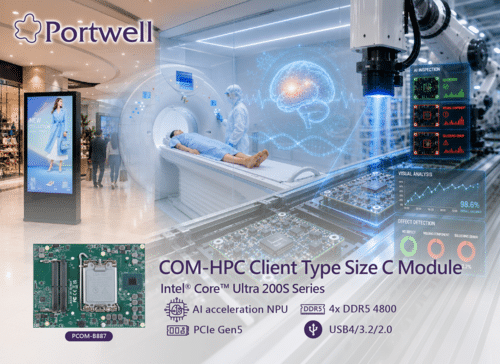
Portwell has released the PCOM-B887, a COM-HPC Client Type Size C module designed for AI-enabled embedded applications. The module complies with the PICMG COM-HPC Revision 1.2 specification and supports Intel Core Ultra 200S Series processors.
The PCOM-B887 combines CPU, GPU, and an integrated Neural Processing Unit (NPU) on a single platform. This enables AI inference at the edge while supporting power-efficient operation for embedded systems.
The module supports Intel Core Ultra 200S Series socket processors, PCIe Gen5 and Gen4, USB4, up to 192GB of DDR5 memory, SATA storage, and multiple display interfaces, including DDI and eDP. These features allow OEMs and system integrators to develop systems for AI inference, graphics processing, and real-time data workloads.
Portwell said the module is designed to combine AI acceleration, high-speed I/O, graphics capabilities, and the flexibility of a standardised modular architecture. Its socketed processor design also allows systems to be adapted to changing performance requirements.
The PCOM-B887 is aimed at applications including factory automation, machine vision, medical equipment, and digital signage. For machine vision workloads, its integrated Intel Xe-LPG GPU supports image processing, while hardware-accelerated AV1 encoding and decoding support video applications.
For medical systems, the module provides graphics capabilities for CT, MRI, and diagnostic imaging applications, along with processor upgrade flexibility. In digital signage applications, it can support up to four independent 4K displays or one 8K display. SR-IOV GPU virtualisation allows multiple independent display content streams to run from a single platform.
With its combination of Intel Core Ultra 200S Series processors, NPU acceleration, graphics processing, memory, and high-speed connectivity, the PCOM-B887 provides a modular option for embedded systems that require AI and computing capabilities.
Click here for the original announcement.