A robotics platform combines CPU, GPU, NPU and FPGA computing to help developers build, test and deploy AI-powered robots.
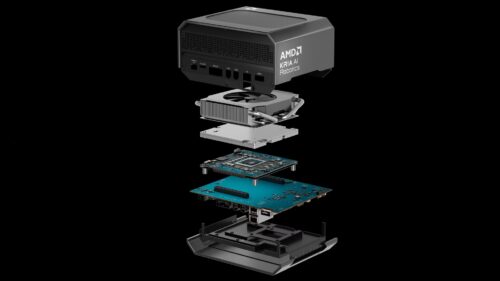
Advanced Micro Devices (AMD) has introduced the Kria AI Solutions portfolio to help developers prototype, build and deploy autonomous robotics and physical artificial intelligence (AI) systems. The portfolio includes Kria AI system-on-modules (SOMs), a robotics carrier card based on the Ryzen AI Embedded X100 Series processors, and the Kria AI Robotics Developer Platform. The platform combines central processing unit (CPU), graphics processing unit (GPU), neural processing unit (NPU) and field programmable gate array (FPGA) computing on a single system to support AI perception, reasoning, decision-making and control while meeting power, thermal and latency requirements.
The platform is designed for developers building robots that require more than fixed automation. As robotics increasingly relies on AI for perception, reasoning and decision-making, developers need hardware and software that reduces design complexity and speeds deployment. The Kria AI SOMs feature Ryzen AI Embedded X100 Series processors with up to 16 Zen 5 CPU cores for control, an RDNA 3.5 integrated GPU for graphics processing, and an NPU for AI workloads. AMD also supports the platform with an open software ecosystem, allowing developers to build and deploy physical AI systems without being tied to a single vendor.
According to the company, the unified memory architecture reduces data movement between computing engines, allowing AI inference, robot control and other workloads to run simultaneously. The company says the platform can perform more than 8000 control decisions per second while completing vision-language-action (VLA) AI reasoning in less than 100 milliseconds. AMD also claims up to 3.4 times better reliability, up to 1.6 times more available CPU cores, and support for up to 2.3 times more concurrent AI agents than the Nvidia Jetson T5000.
The Kria AI Robotics Developer Platform includes the Kria AI SOM, a robotics carrier card, an evaluation kit, the AMD Robotics Software Suite and reference designs. The software stack is based on AMD ROCm software and the ROS 2 robotics framework, providing a development environment for robotics applications.
The platform supports AI and robotics frameworks including PyTorch, ONNX, ROS 2 and MoveIt. It also supports compute unified device architecture (CUDA)-to-ROCm migration, allowing developers to reuse about 75 per cent of their existing CUDA code, according to AMD. Hardware from ODM partners is intended to help developers transition from development to production.
Click here for the original announcement.