




New embedded processors combine CPU, GPU, and AI processing on one chip to run AI in robots, machines, and medical devices.
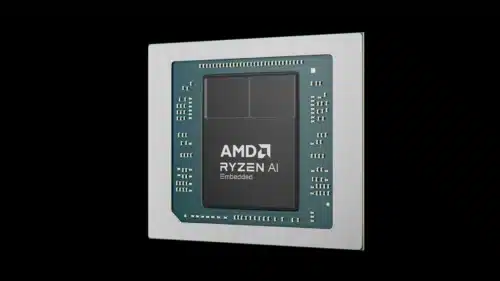
AMD has introduced the Ryzen AI Embedded X100 Series processors for embedded systems that run AI workloads in real time. Built on a single system-on-chip (SoC), the processors combine up to 16 AMD “Zen 5” CPU cores, an integrated GPU, and a neural processing unit (NPU) with a unified memory architecture. They are designed for applications that require fast AI processing with low latency, including robotics, industrial automation, healthcare equipment, aerospace, defence, and other embedded systems.
Physical AI applications need processors that can analyse data, make decisions, and respond in real time while operating within limited power, thermal, and space budgets. The Ryzen AI Embedded X100 Series is designed to support these requirements by combining CPU, GPU, and AI acceleration on one chip, enabling autonomous systems to perform perception, reasoning, and control tasks more efficiently.
The processors support Linux, the AMD ROCm software stack for GPU acceleration, Xen Hypervisor for virtualisation, and AI frameworks such as PyTorch, ONNX, and TensorFlow. Developers can also migrate existing CUDA-based applications to ROCm using migration tools, allowing software development without dependence on a single ecosystem.
For industrial and embedded deployments, the processors support operation in temperatures ranging from -40°C to 105°C and are designed for continuous 24/7 use, with a planned product availability of up to 10 years.
According to AMD, the Ryzen AI Embedded X100 Series delivers up to 2.1× higher multi-threaded CPU performance (CoreMark), 1.7× higher graphics performance (OpenGL), and 3.5× higher AI token generation throughput with 1.4× faster time-to-first-token compared with Intel Core Ultra Series 3 processors. For signal-processing applications such as medical ultrasound beamforming, AMD also claims up to 3× higher peak FP32 performance than Nvidia Jetson T5000 and an average 1.7× higher performance than Nvidia RTX 4000 Ada GPUs.
The processors can be used in applications such as humanoid robots, smart manufacturing systems, surgical robots, autonomous machines, unmanned platforms, and advanced medical devices that require AI processing and real-time control.
New embedded processors combine CPU, GPU, and AI processing on one chip to run AI in robots, machines, and medical devices.
Click here for the original announcement.

