




A vehicle system removes particles from surrounding air and captures brake dust while driving, reducing non-exhaust particle emissions.
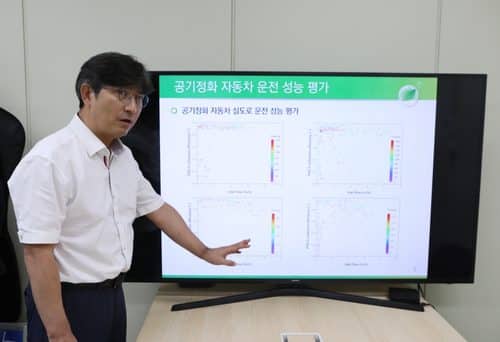
A vehicle-based air purification system developed by the Korea Institute of Machinery and Materials (KIMM) can remove fine particulate matter from surrounding air while driving and capture brake wear particles before they are released.
The system combines a grille-type electrostatic precipitation system for roadside fine particulate matter, a calliper-type brake dust collection system for brake wear particles, and a wireless power transfer system for air purification while the vehicle is parked.
Testing showed that the grille-mounted electrostatic precipitation system removed at least 95% of PM2.5 and at least 99% of particles in the PM2.5–10 range at 30 km/h. It maintained the same performance at 50 km/h and could purify about 1,800 m³ of air per hour per vehicle. The systems were installed and tested on different vehicle models, including the Kia Carnival and Hyundai Sonata.
The grille-type system electrically charges particles entering through the vehicle grille and attracts them to collection plates. It uses carbon fibres thinner than a human hair, allowing particles to be collected using low electrical current while limiting ozone generation. During driving, the system uses airflow generated by the moving vehicle instead of a separate high-power blower. When the vehicle is parked in an area equipped with wireless power, its radiator fan draws surrounding air through the purification system.

The brake particle collection system is installed behind the brake calliper. Friction between the brake pads and discs naturally gives the particles an electrical charge, allowing the system to collect them without a separate particle charger or suction fan. Under the Worldwide Harmonised Light Vehicles Test Cycle (WLTC), it captured 22.2 mg of brake wear particles per kilometre per vehicle, equivalent to about 10 g over a 450-km drive.
The technology uses existing vehicle structures and components. The electrostatic precipitation system has low airflow resistance, reducing the additional power and structural changes required for installation. The development addresses non-exhaust particulate matter from brakes and tyres, including emissions from electric and hydrogen-powered vehicles that do not produce conventional engine exhaust emissions.
The technology could be used as vehicle emission regulations become stricter, including requirements for brake particle emissions under Euro 7.
The research team plans to expand the technology through AirFive, one of KIMM’s Five Flagship Brands. Further testing is planned under real-world driving conditions to evaluate performance and long-term durability.


