




Robots sort, test, and recover used EV battery cells for reuse, extending battery life, reducing waste, and improving recycling efficiency and safety.
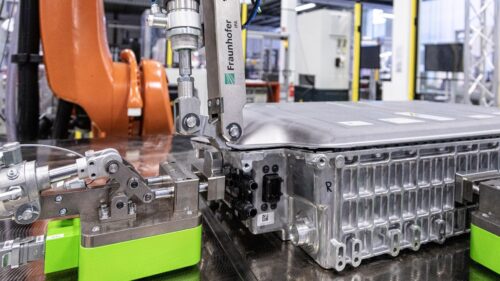
German researchers are developing an automated robotic system to identify, dismantle, and recover used electric vehicle (EV) battery cells for reuse, potentially reducing waste and extending battery life before recycling becomes necessary.
The project, called RoB@t2Cell, is led by Fraunhofer Institute for Manufacturing Engineering and Automation IPA alongside industry and research partners. Its goal is to solve one of the biggest challenges in EV battery recycling: separating cells that can still be used from those that must be discarded.
Most EV batteries still hold significant residual voltage after their first life in a vehicle, making them hazardous to handle. To reduce the risk of electrical accidents, recyclers typically drain them completely before dismantling. But that process can destroy cells that remain functional, limiting opportunities for reuse.
RoB@t2Cell is designed to change that by allowing robots to assess each battery cell individually and determine its next step—whether that means direct reuse, remanufacturing, or full material recycling.
The system uses automated dismantling technology to break battery packs down to the cell level and expose their terminals for testing. It then evaluates the condition of each cell and adjusts the discharge process depending on its future use.
Cells marked for recycling are deeply discharged, while those suitable for reuse are only partially discharged and stabilized at a specific charge level to preserve their remaining capacity.
That targeted approach could help recover more value from aging EV batteries by keeping usable cells in circulation longer instead of sending them straight into recycling streams.
The technology will next be tested in industrial pilot operations at Umicore, where researchers will evaluate how well it performs at scale. The team is also working on newer battery pack designs that rely on adhesive bonding, which can be more difficult to take apart than traditional mechanically fastened systems.
For batteries that can no longer be reused, the project also focuses on improving material recovery. Researchers are developing automated cell-opening methods to prepare battery components for water-based recycling processes aimed at recovering critical raw materials more efficiently.


