
A hidden manufacturing defect in high-nickel EV battery cathodes that accelerates degradation, while proposing a simple materials-processing modification that significantly improves battery durability and long-term performance.
As automakers increasingly adopt cobalt-free, high-nickel lithium-ion batteries to reduce costs and extend electric vehicle range, researchers have identified a previously overlooked manufacturing flaw that could significantly shorten battery life. The study reveals that a subtle chemical change occurring before the battery is even assembled can accelerate long-term degradation, while a straightforward manufacturing adjustment can largely eliminate the problem.
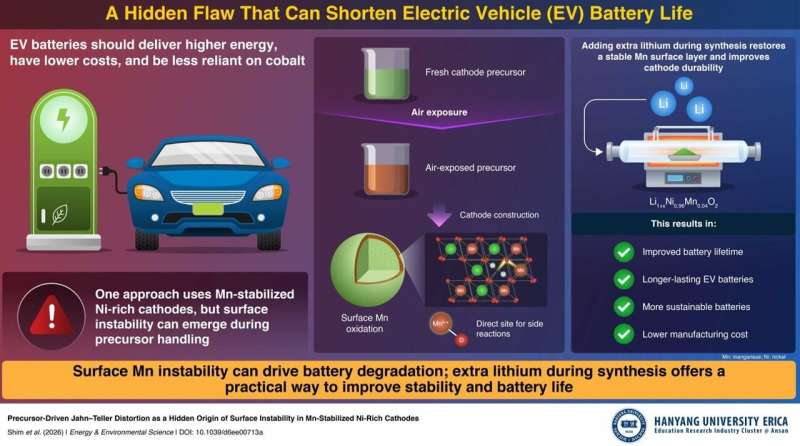
The research, conducted by a team at Hanyang University in South Korea and published in Energy & Environmental Science, focuses on manganese-coated nickel-rich cathodes, one of the leading candidates for next-generation EV batteries. These cathodes replace expensive cobalt with manganese to improve affordability while maintaining high energy density. However, the researchers found that exposing cathode precursor materials to air during storage causes manganese atoms on the particle surface to oxidize before battery fabrication begins.
This oxidation creates defective surface regions containing Jahn-Teller distorted manganese species. Although invisible during routine manufacturing, these defects become highly reactive once the battery is in operation. They trigger electrolyte decomposition, dissolve transition metals from the cathode, and promote damaging side reactions at the graphite anode. Collectively, these effects nearly double the rate of capacity loss during extended charge-discharge cycling, substantially reducing battery lifespan.
Instead of requiring expensive redesigns or additional protective coatings, the researchers demonstrated a practical solution. By increasing the amount of excess lithium used during cathode synthesis, they suppressed the formation of the unstable surface phase and restored stable manganese-oxygen bonding. Batteries produced using this modified process retained more than 90% of their original capacity after long-term cycling, indicating a significant improvement in durability.

The findings highlight that battery longevity depends not only on material selection but also on how precursor materials are stored and processed before production. As manufacturers accelerate development of cobalt-free, nickel-rich batteries for electric vehicles and grid-scale energy storage, tighter control over precursor handling and lithium stoichiometry could become a cost-effective method to enhance reliability without major production-line changes.
Beyond electric vehicles, the study provides valuable guidance for battery manufacturers developing high-energy lithium-ion cells for renewable energy storage, where long operational life and consistent capacity retention are essential for reducing lifecycle costs.