




A soft robot modelled on a beetle walks, turns and grips objects under finger-based control, while sending visual and tactile feedback to its operator.
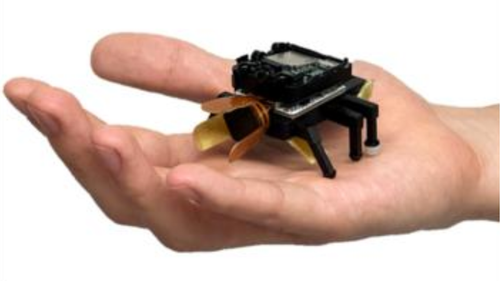
A soft robot inspired by a beetle can walk, turn and grip objects in response to finger movements. Called BeetleBot, the robot was developed by researchers from the Korea Advanced Institute of Science and Technology (KAIST), the California Institute of Technology (Caltech) and Nanyang Technological University (NTU), Singapore. It combines heat-driven artificial muscles, a wearable sensor, a camera and a tactile sensor to let an operator control its movements and receive information about its surroundings.
Unlike conventional small robots that use rigid structures and electric motors, BeetleBot relies on artificial muscles made from a three-dimensionally printed liquid crystal elastomer. The material contracts when heated, generating movement without conventional motors. The researchers aim to use this approach to develop robots that can operate in confined spaces, inspect machinery and retrieve small objects in environments that are difficult for people to access.
The robot’s movement is controlled through a stretchable sensor patch worn on the operator’s finger. The patch contains carbon nanotubes whose electrical resistance changes as the finger bends and straightens. Software interprets these changes as four commands: forward, left, right and grip. The commands are transmitted to the robot through Bluetooth Low Energy (BLE), allowing the operator to control it wirelessly.
An onboard module converts electrical energy into heat to activate the artificial muscles. By controlling different muscles independently, the researchers can make the robot move forwards or turn in either direction. Its soft construction is intended to help it navigate obstacles and interact with objects without relying entirely on rigid mechanical components.
BeetleBot also incorporates a gripping mechanism modelled on the mandibles of a beetle. A capacitive pressure sensor integrated into the jaws detects contact with objects, while a small onboard camera provides visual information about the surroundings. This combination gives the operator both visual feedback and an indication of when the robot has touched an object.
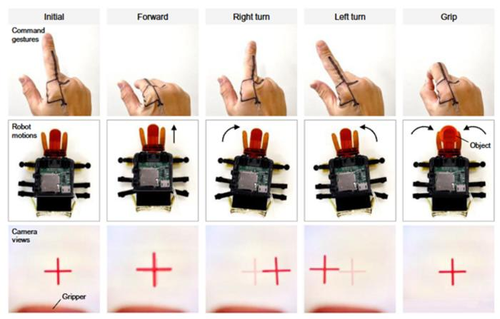
According to Inho Kim, the study’s first author, the bidirectional feedback system connects information detected by the robot to the operator’s subsequent actions. Kim conducted the research as a postdoctoral researcher at Caltech and is now an assistant professor at Sungkyunkwan University.
The researchers demonstrated BeetleBot navigating around obstacles, approaching a target and gripping and carrying an object. These experiments show how its artificial muscles, wearable sensor and feedback system work together. However, the available research announcement does not provide key performance figures such as walking speed, payload capacity, battery life, weight or operating temperature. These details would need to be confirmed from the research paper and its supplementary material before comparing the robot with existing inspection systems.
The technology remains at the laboratory-prototype stage. The researchers identify actuation speed, energy efficiency and the power supply as areas requiring further development. Heat-driven artificial muscles can also respond more slowly than conventional motor-based actuators, potentially limiting their usefulness in applications that require rapid movement. BeetleBot has not yet been established as a commercially available system, and its performance in real industrial environments remains to be evaluated.
For India, BeetleBot’s combination of soft robotics, gesture-based control and tactile sensing could inspire compact robots for inspecting machinery, navigating narrow ducts and retrieving objects from restricted spaces. Indian robotics company Genrobotics has developed Bandicoot for sewer-cleaning applications, demonstrating how robots can address hazardous work. Although BeetleBot has not been tested in these Indian applications, its approach could offer a research direction for Indian engineering institutions and robotics developers exploring remote inspection systems for industrial facilities and utility infrastructure.
For more information, click here.
