




A new chip copies how brain cells work, helping quantum computers process data while using less power at low temperatures.
Researchers at the University of Hong Kong (HKU) have developed a programmable neuromorphic hardware platform that operates at temperatures close to absolute zero. The technology could help overcome one of the major challenges in scaling quantum computers by enabling low-power control electronics to operate near qubits. It could also support electronics for deep-space missions, where extremely low temperatures are common.
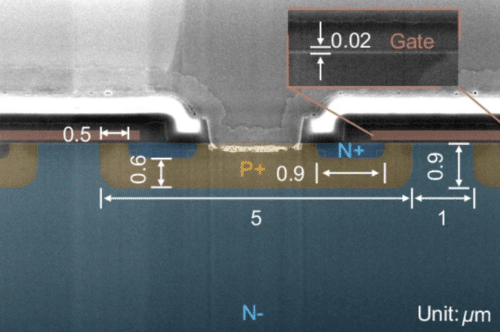
The research team built the platform using standard silicon carbide (SiC) MOSFETs. They demonstrated that a single transistor can reproduce the “spiking” behaviour of biological neurons at temperatures as low as 10 millikelvin (mK).
Quantum computers require control electronics to manage qubits, which operate at millikelvin temperatures. Conventional silicon-based controllers generate too much heat and are typically placed away from the qubits, requiring large numbers of connecting wires. This limits the size and performance of quantum systems.
To address this, the researchers developed a method to generate and control negative differential resistance (NDR) in SiC MOSFETs. When cooled below 2 kelvin (K), the transistors showed an “S-shaped” NDR effect driven by electron-donor impact ionization (EDII). Unlike approaches that depend on heat, this mechanism comes from the material’s atomic properties, making it stable and repeatable.

The team also showed that multiple neuron-like transistors can be connected to form larger networks for local data processing at cryogenic temperatures. Such networks could improve quantum error correction and real-time control inside quantum computers while reducing power consumption and thermal load.
Because silicon carbide is already widely used in electric vehicles and power systems, the researchers say the technology could be manufactured using existing semiconductor foundries on 300 mm wafers.
Beyond quantum computing, the cryogenic circuits could also be used in deep-space exploration, where electronic systems must operate reliably in extremely cold environments.


