




Researchers have modelled how hydrogen bubbles affect electrode performance, identifying a critical size beyond which the additional voltage requirement rises sharply.
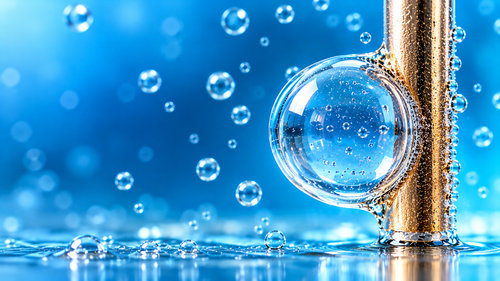
Hydrogen bubbles forming on electrolyser electrodes can increase the energy required to produce hydrogen. Researchers from Cornell University and City University of Hong Kong have developed a three-dimensional model to study how individual bubbles affect this process, identifying a critical bubble size beyond which energy losses rise sharply.

This research modelled the formation of one hydrogen bubble attached to an electrode in an alkaline water electrolyser system. The area occupied by the bubble on the electrode surface was found to be the dominant source of bubble-induced energy loss.
Headed by Lenan Zhang of Cornell University and Weihong Li of City University of Hong Kong, the study deals with the problem of analyzing the effect of bubbles on an individual scale. As Zhang stated, “It’s really challenging to isolate the impact of bubbles on each individual scale.”
Headed by Lenan Zhang of Cornell University and Weihong Li of City University of Hong Kong, the study deals with the problem of analyzing the effect of bubbles on an individual scale. As Zhang stated, “It’s really challenging to isolate the impact of bubbles on each individual scale.”

A ratio was also developed by the team for the separation radius and critical radius of the bubble. Simulation results indicated that the voltage increment due to a single bubble is constrained to 3 percent when the above ratio stays below one. Nevertheless, in some simulated examples, the rise in voltage was higher than that without the bubble by over 50 percent.
This model is 1,000 times faster than any other similar model for equivalent calculations, according to Cornell. Therefore, one can easily perform large-scale simulations using different types of electrodes.
At the present time, it is a result of computer simulation of only one bubble, instead of any experimental evidence or multiple bubbles interaction. Among the subsequent tasks of the scientists there are modeling the interaction between bubbles and the combination of the model with computational optimization and additive manufacturing.
India’s National Green Hydrogen Mission targets 5 million tonnes of annual green hydrogen production capacity by 2030. Since electrolysers use electricity to split water, reducing the additional voltage required to overcome bubble-related losses could help improve their energy efficiency. The study may therefore offer useful design insights for future electrolyser development.
For more information, click here.

