




A diode design can make terahertz signals stronger and work better, helping build smaller devices for imaging, sensing, and wireless communication.
Terahertz radiation, lying between microwaves and infrared light, is used in imaging and wireless communication, but producing strong, continuous signals is difficult. Engineers often use frequency multipliers, circuits that convert an input signal to a higher frequency, with some using Schottky barrier diodes, where a metal and semiconductor junction acts like a one-way electrical valve. Single-diode multipliers are limited in energy handling, and chaining multiple diodes can increase capacity, but uneven electromagnetic field distribution along the chain can lower efficiency.
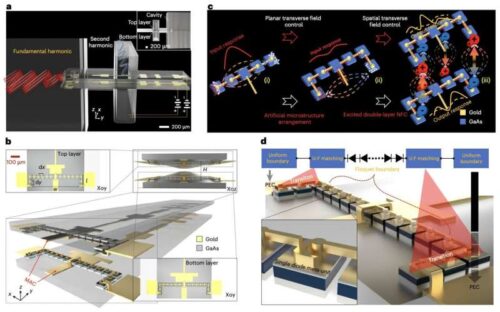
Researchers at the University of Electronic Science and Technology developed a new diode chain design to solve this problem. Their asymmetric C-shaped diode chain reshapes local electromagnetic fields to distribute energy evenly. The design multiplies frequencies more efficiently than existing diode-based multipliers.
Frequency multiplier devices based on Schottky barrier diodes can generate terahertz radiation, offering high power output and integration into all-solid-state systems. The scaling of output power of such devices is limited by the power handling capacity of a single diode. A connected chain of Schottky barrier diodes, combined with a power-combining approach, can increase terahertz output power. Uneven field distribution among the diodes, caused by the similarity between the terahertz wavelength and the physical dimensions of the diodes, leads to lower efficiency and early breakdown.
To overcome the limitations of single diode-based and diode chain-based frequency amplifiers, a new design arranges diodes in a double-layer chain shaped like the letter C. The chain is asymmetric, which improves the flow of electromagnetic fields between diodes.
The performance of the diode chain was tested in simulations and laboratory tests. It achieved one of the highest terahertz frequency-doubling efficiencies reported, reaching a frequency-doubling efficiency of 38% and an output exceeding 300 mW at 170 GHz.
The C-shaped diode chain could be improved and used to develop a range of electronic devices. In the future, it could enable compact terahertz wave transmitters and generators, supporting imaging, sensing, and communication systems.

