A chip-scale atomic clock provides satellite timing, radiation tolerance, low power consumption, and synchronisation for navigation and communication systems.
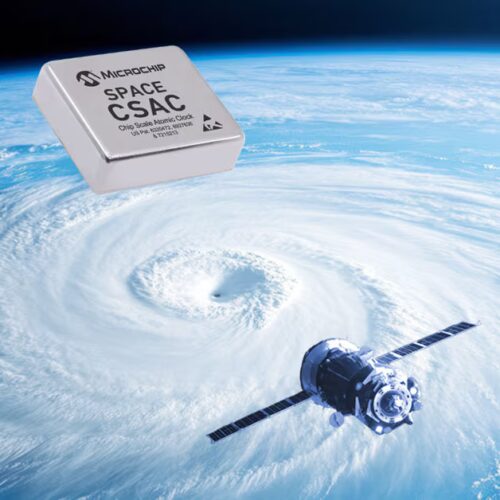
Microchip Technology has expanded its atomic clock portfolio with the Space CSAC-SA65, a chip-scale atomic clock designed for satellite systems. It is aimed at space applications including satellite-to-cellular communications, alternative navigation, and Earth imaging, where size, weight, power, and cost are key considerations.
The Space CSAC-SA65 is designed for Low Earth Orbit (LEO) missions and can be used for satellite timing and frequency control, satellite clock references, assured positioning, navigation and timing (PNT), and satellite cross-linking.
The device provides radiation tolerance of at least 30 kRad and operates across temperatures from –40°C to +80°C. It consumes less than 120 mW and occupies less than 17 cc.
The CSAC-SA65 includes 1 PPS input and output for system synchronisation. Its atomic timing stability allows satellite systems to maintain timing for longer periods without continuously depending on external references such as GNSS signals.
The device builds on Microchip’s Space CSAC-SA45 and is manufactured as a Commercial Off-The-Shelf (COTS) product using radiation-tolerant commercial electronic components. This approach can reduce lead times and costs compared with traditional space-grade oscillators.
The CSAC-SA65 is supported by Microchip’s Clockstudio software for atomic clock control and analysis. It is also supported by the CSAC Developer Kit for development and evaluation.
“By enabling one of the lowest power atomic clocks to thrive in extreme conditions, even the smallest CubeSat can now fly with atomic accuracy,” said Randy Brudzinski, corporate vice president of Microchip’s frequency and time systems business unit. “The Space CSAC-SA65 brings atomic-clock performance to applications where size, weight, power and cost are tightly constrained, helping developers maintain synchronisation and timing accuracy even when external timing references are unavailable.”
Click here for the original announcement.