Palm-sized split-core sensors combine high measurement accuracy, wide bandwidth, and clamp-on installation for demanding current-monitoring applications.
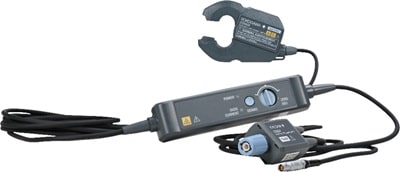
Accurate current measurement in confined spaces is becoming increasingly important as electric vehicles, renewable-energy systems, HVAC equipment and AI data-center infrastructure adopt more compact power architectures. Addressing these requirements, Yokogawa Test & Measurement Corporation is introducing the CT500SA and CT200SA AC/DC split-core current sensors, scheduled for release on September 9, 2026. The sensors provide 500 A and 200 A measurement capabilities, respectively, while combining the installation convenience of a clamp-on design with accuracy typically associated with through-hole sensors.
The CT500SA and CT200SA are designed for applications where cables cannot easily be disconnected or cut and access around the measurement point is restricted. Their compact sensor bodies measure just 110 mm × 62 mm × 25 mm, allowing them to be installed around conductors in space-constrained environments. A single unlock-and-open mechanism enables one-handed installation, while an M4 screw hole and cable-tie slot help secure the sensor and maintain consistent positioning during measurements.
The key features are:
- 200 A and 500 A measurement ranges
- ±0.09% of reading + 0.01% of full-scale accuracy
- Frequency bandwidth up to 1 MHz (−3 dB)
- ±0.1° phase accuracy from 0.1 Hz to 1 kHz
- Direct compatibility with power analyzers and waveform instruments
For engineers validating electric-vehicle powertrains, the sensors enable current measurements around inverters and motors even after vehicle assembly, when available installation space can be limited. Their split-core construction also simplifies repeated sensor installation and removal during different testing stages.
The sensors combine broad frequency response with high measurement accuracy, making them suitable for analysing rapidly changing currents and switching waveforms. The CT500SA provides bandwidth up to 500 kHz, while the CT200SA extends to 1 MHz, supporting measurements of PWM-controlled inverter outputs and their harmonic components. This makes the devices useful for inverter efficiency analysis and power-conversion evaluation.
Both models can also be connected directly to power analyzers and waveform measurement instruments. This enables engineers to use the same current signal across different measurement tasks without changing sensors or adding conversion accessories, helping simplify test setups and improve measurement consistency.
Beyond xEV testing, the sensors can be applied to PV system output-current measurement, renewable-energy performance evaluation, HVAC current monitoring and power-conversion equipment used in AI data centers. Their combination of compact construction, split-core installation and wideband measurement makes them suited to both product development and real-world validation where conventional current sensors can be difficult to install.
Click here for the original announcement.