

A low-resistance design helps automotive-compliant Hall effect current sensors reduce heat while measuring current in EV chargers and industrial equipment.
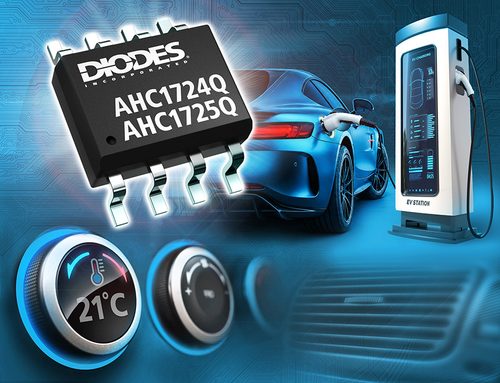
Diodes Incorporated has launched AHC1724Q and AHC1725Q automotive-compliant Hall effect current sensors. The company claims that the sensors provide accurate, galvanically isolated AC and DC measurements for onboard chargers (OBCs) and charging stations. Their small size also helps you design more compact circuit boards, especially where space is limited.

The Hall effect current sensors combine a copper path that carries electrical current with a Hall sensor that measures it. The copper path has 1.2 milliohms of resistance, which is considered very low; hence, less energy is wasted as heat. The sensors measure currents up to ±50A, with options to measure current flowing in one direction or both directions.
The sensors’ design has an electrically isolated path through which the current flows and a separate sensing circuit that measures the current. This allows them to safely measure current on the high-voltage side without using additional isolation circuits. They support a maximum working voltage of 420V DC and meet the basic insulation requirements of the UL 62368-1 safety standard.
A low-offset, chopper-stabilised architecture reduces small errors in the measurement, helping the devices provide more accurate current readings. The devices can accurately respond to current changes occurring at high frequencies, up to their specified bandwidth of 120kHz. They feature a response time of 4.0µs and a propagation delay of 2.0µs. The output voltage also changes in proportion to the supply voltage.

The release also states that the sensors are safe to use in industrial equipment that operates in harsh conditions and at high temperatures, such as power supplies, load detection and management systems, overcurrent fault protection systems and HVAC systems.
Click here for the original announcement.