A student-built electric vehicle uses electrostatic particle capture, lightweight composites, and driver feedback to reduce particulate emissions from tyres and brakes.
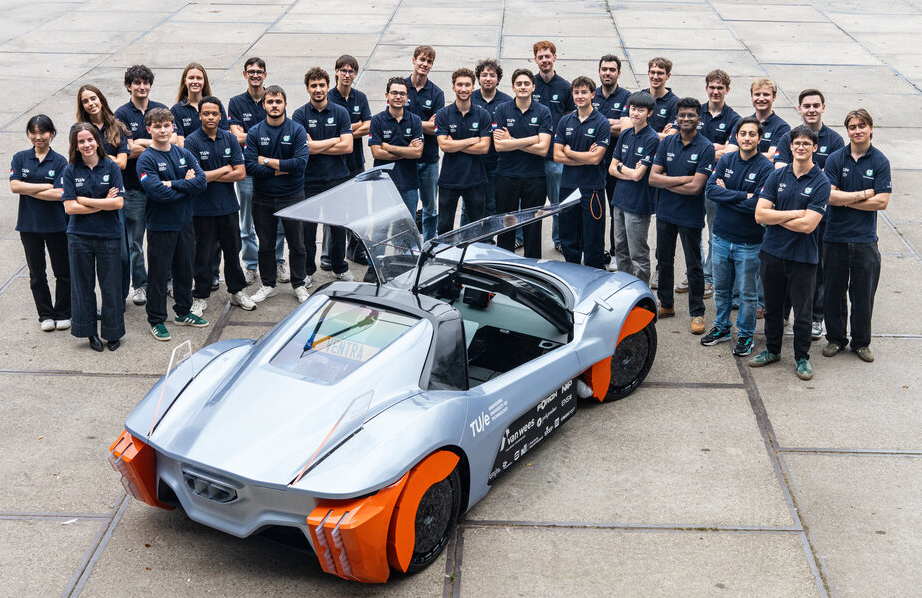
A student team at Eindhoven University of Technology has developed an electric car designed to tackle a source of pollution that conventional EVs do not eliminate: particulate matter generated by tyres, brakes, and road contact. The vehicle, called VENTRA, combines an electrostatic particle-capture system with a lightweight chassis and software that encourages driving behaviour that produces less wear.
At the centre of the concept is the T.R.A.C.E. particulate-capture system, positioned around the wheels. Instead of using a conventional filter that can restrict airflow, the system electrically charges airborne particles and attracts them towards grounded collection surfaces. This electrostatic precipitation approach is intended to capture particles while maintaining relatively low airflow resistance. The collected material can then be removed from the vehicle and potentially reused.
According to the team’s simulations, the system can capture more than 24% of tyre-generated particulate matter when the vehicle travels between 50 and 80 km/h. During slower urban driving, where airflow around the wheels is lower, fans can actively move contaminated air through the capture system, increasing the simulated collection rate to 42%.
VENTRA also addresses particulate pollution by reducing the amount of material generated in the first place. Its chassis uses carbon-fibre-reinforced thermoplastic composite sandwich panels, with the complete chassis weighing about 135 kg and the monocoque weighing approximately 45.5 kg. The complete vehicle weighs around 790 kg. Lower vehicle mass can reduce the forces acting between tyres and the road, potentially lowering tyre abrasion.
The vehicle further uses a system called Clean Drive to influence driving behaviour. It monitors acceleration, braking, and steering and provides feedback intended to encourage smoother inputs. Less aggressive acceleration and braking can reduce tyre and brake wear, complementing the physical particle-capture system.
The approach highlights an emerging direction for electric-vehicle engineering: addressing emissions beyond the absence of a tailpipe. By combining particle generation reduction, electrostatic collection, lightweight materials, and software-assisted driving, VENTRA demonstrates how vehicle electronics and mechanical design can work together to tackle non-exhaust pollution.