The self-powered device mimics the human eye, recognizing colors while using energy, improving devices like phones, drones, and cars.
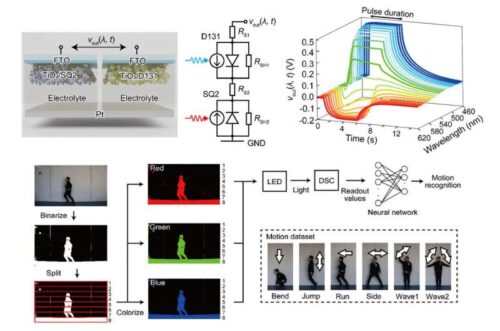
As AI and smart devices become more common, machine vision helps a lot but uses too much power and memory, making it hard to use in phones, drones, or cars. The human eye works differently—it only pays attention to what’s important, saving energy. Scientists try to copy this with neuromorphic computing to solve machine vision problems, but it still can’t recognize colors like humans or work without extra power. To fix this, a team at Tokyo University of Science in Japan created a new self-powered artificial synapse that can tell colors apart very accurately.
The team engineered the device by combining two distinct dye-sensitized solar cells, each responsive to different light wavelengths. Unlike traditional optoelectronic artificial synapses that rely on external power sources, this synapse harnesses solar energy to generate its own electricity. This self-sustaining feature makes it especially well-suited for edge computing applications, where minimizing energy consumption is essential.
Extensive experiments demonstrated that the developed system can distinguish colors with a resolution of 10 nanometers across the visible spectrum, approaching the discrimination level of the human eye. Additionally, the device exhibited bipolar responses, generating positive voltage under blue light and negative voltage under red light. This capability allows it to perform complex logic operations that would normally require multiple conventional components.
To showcase a practical application, the device was incorporated into a physical reservoir computing framework to recognize various human movements recorded in red, green, and blue. The system achieved an impressive 82% accuracy in classifying 18 different combinations of colors and movements using a single device, compared to the multiple photodiodes typically needed in standard systems.
The potential impact of this technology spans numerous industries. In autonomous vehicles, it could enhance the efficient recognition of traffic lights, road signs, and obstacles. In healthcare, it may enable wearable devices that monitor vital signs such as blood oxygen levels while minimizing battery consumption. For consumer electronics, the technology promises smartphones and augmented/virtual reality headsets with significantly improved battery life without sacrificing advanced visual recognition.
Reference: Hiroaki Komatsu et al, Polarity-tunable dye-sensitized optoelectronic artificial synapses for physical reservoir computing-based machine vision, Scientific Reports (2025). DOI: 10.1038/s41598-025-00693-0