

Espressif has released a Wi-Fi Aware component and iOS demo that lets an ESP32-C5 connect directly to an iPhone without a Wi-Fi access point.
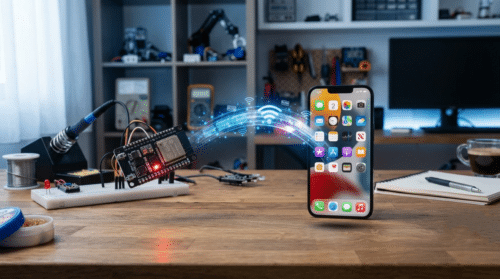
Getting an ESP32 board to communicate with an iPhone has typically required a Wi-Fi access point or a Bluetooth connection. Espressif has now demonstrated another option. A walkthrough published on the Espressif Developer Portal shows an ESP32-C5 communicating directly with an iPhone over Wi-Fi Aware, without requiring a router, access point or internet connection.
Wi-Fi Aware, also known as Neighbour Awareness Networking (NAN), is a Wi-Fi Alliance standard that allows nearby devices to discover each other and establish direct connections without a conventional access point. Devices synchronise into a cluster, advertise and discover services by name, and can then create an encrypted peer-to-peer data link. In Espressif’s demo, the service follows the DNS Service Discovery (DNS-SD) convention and is advertised as _ESP-Demo._udp. Pairing uses a six-digit PIN and provides security equivalent to WPA3-PSK, with the demo using 000000 as its default PIN. On the iPhone, the connection is exposed as an ordinary IPv6 socket through Apple’s Network framework, so application software can communicate through a standard socket interface rather than a proprietary transport.
Until now, engineers building a phone-to-board connection have generally had two options. Bluetooth Low Energy (BLE) works without a network but offers much lower bandwidth than Wi-Fi and is less suitable for bulk data transfers. The alternative is SoftAP mode, where the ESP32 creates its own Wi-Fi network for the phone to join. While this provides higher bandwidth, it can disconnect the phone from its existing Wi-Fi network and interrupt internet access during provisioning. Wi-Fi Aware avoids that trade-off by allowing the phone to maintain its existing network connection while establishing a separate, encrypted IP link directly with the ESP32. For applications such as device provisioning, over-the-air firmware updates and downloading data from a local sensor or data logger, the approach provides a faster connection without requiring an additional router or access point.
On the hardware side, the demonstration uses the ESP32-C5, Espressif’s dual-band Wi-Fi 6 microcontroller supporting both 2.4 GHz and 5 GHz operation. The Wi-Fi Aware component currently supports the targets listed in its component documentation and requires ESP-IDF 6.1 or later, with Espressif marking the pairing and security features as experimental in v6.1. On the Apple side, the demonstration requires iOS 26 or iPadOS 26 and compatible devices, including iPhone 12 or later, iPad 10th generation, iPad Air 4th generation, iPad mini 6th generation and supported iPad Pro models. The ESP component is available as espressif/wifi_aware v0.1.0 or later through the ESP Component Registry, while the iOS demonstration application is available as open source code on GitHub.
Espressif publishes no throughput, range or power-consumption figures for the Wi-Fi Aware implementation, so engineers budgeting a link should measure those parameters rather than assume performance. Wi-Fi Aware also does not run in the iOS simulator, requiring a physical compatible device for development. A more significant commercial constraint is Apple’s managed Wi-Fi Aware entitlement: developers must request the capability for their App ID and wait for approval before the app can be signed and tested. That makes Apple’s review process a potential development and release schedule risk rather than a simple software setting. Vendor name, model name and pairing name are each limited to 15 characters. To clear stored pairing credentials, Espressif’s ESP-DevKitC boards require a three-second press of the BOOT button, while the iPhone requires Reset WLAN Identifier in its Accessories settings.
Wi-Fi Aware operates in India’s licence-exempt Wi-Fi spectrum, so it does not introduce a separate spectrum allocation requirement. A finished wireless product would still need to meet the applicable WPC Equipment Type Approval requirements, while any BIS certification or registration would depend on the product category and relevant Indian standard. Espressif also has an engineering centre in Pune, established to support embedded software engineering and IoT solutions development. For Indian product teams, the more immediate limitation is device compatibility: this particular demonstration requires iOS 26 and a compatible iPhone or iPad, while Android remains the dominant smartphone platform in India. Wi-Fi Aware is therefore an interesting option for products targeting Apple users, rather than a universal phone-based provisioning solution today.
For more information, click here.