




LakeShark combines an ESP32-P4, touchscreen and multiple radio receivers for portable RF scanning and signal decoding.
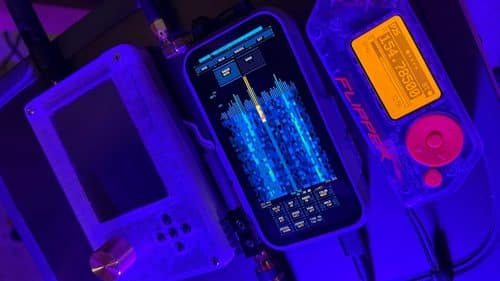
Software-defined radio (SDR) receivers have changed the way signals are analysed by shifting hardware-based filtering and demodulation to software-based implementations. On the other hand, the need for capturing and visualisation of wideband radio signals in real-time requires interfacing USB-based SDR dongles to laptops, tablets, or single-board computers that are power-hungry. The open source LakeShark project eliminates these external host devices by turning compact microcontroller hardware into an autonomous, pocket-sized RF spectrum scanner and signal visualiser.

At the heart of the project stands the ESP32-P4. Being driven by the two high-frequency cores of reduced instruction set computer five (RISC-V) application processor type, the processor has enough computing power to calculate the FFT in real time on board. Using native MIPI-DSI displays, the device drives capacitive touch screens to show waterfall diagrams, frequency spectra, and signal strength meters without any frame drops.
The software platform interfaces with low-cost SDR hardware to tune across extensive radio frequency bands. Users can inspect local RF activity across sub-GHz industrial bands, amateur radio allocations, and aviation frequencies. It also supports LoRa radio modules such as the SX1262 and LR2021. LakeShark renders touch-optimised menus and controls for adjusting centre frequency, gain levels, bandwidth spans, and visualisation parameters directly on its built-in display.
Transitioning from a generic operating system used in a desktop computer to an embedded microcontroller results in significant improvements in energy efficiency and compactness of the device. In particular, the scanner turns on very quickly. It requires little energy from its internal lithium-polymer battery and is easily portable. As such, it can be used efficiently by field engineers who need to carry out local signal scans, find radio interference sources, or evaluate wireless telemetry communications.
In view of the growing wireless infrastructure in India in terms of communications systems, smart metering systems, and localised IoT implementations using different frequency bands, it becomes increasingly necessary to have small-scale diagnostic kits. Open source LakeShark can be used by local engineers, researchers working on wireless communications, and amateur radio enthusiasts for quick testing of sub-GHz radios and for debugging embedded wireless modules in the field.
By showing that real-time signal processing and high-end graphics rendering can be done effectively using today’s RISC-V microcontroller chips, LakeShark shows how much more capable embedded silicon is at being used in test and measurement instruments.
For more information, click here.


