

Espressif’s new ESP_Video library lets Arduino sketches capture video from MIPI-CSI and DVP cameras on ESP32-P4 and ESP32-S3 boards without requiring a separate ESP-IDF project.
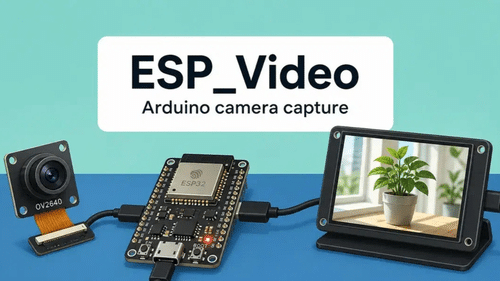
Espressif has added camera capture support to the Arduino environment through its new ESP_Video library, allowing developers to access MIPI-CSI and digital video port (DVP) cameras from Arduino sketches. The library supports mobile industry processor interface camera serial interface (MIPI-CSI) on the ESP32-P4 and DVP camera interfaces on both the ESP32-P4 and ESP32-S3, bringing camera functions previously accessed through Espressif’s ESP-IDF video stack into the Arduino development environment.
The ESP32-P4 is a dual-core reduced instruction set computing-five (RISC-V) microcontroller running at up to 400MHz. It includes a MIPI camera serial interface with an integrated image signal processor, while also supporting a digital video port for parallel camera connections. The ESP32-S3 supports DVP camera input.
ESP_Video wraps Espressif’s esp_video ESP-IDF component in C++ classes for Arduino. Its programming model follows a video-device workflow: configure the camera interface, open a video device, start capture and retrieve frames. On the ESP32-P4, the MIPI-CSI and DVP interfaces are exposed through separate video device nodes, with MIPI-CSI available as /dev/video0 and DVP as /dev/video2. The two interfaces can operate simultaneously, allowing two camera paths to be used on the same microcontroller.
Espressif provides mipi_csi_camera.ino and dvp_camera.ino examples with the Arduino-ESP32 core. The examples initialise the respective camera interface, start capture and retrieve frames, then report frame metadata through the serial monitor. This includes information such as frame size, format, width and height, providing a basic way to verify camera operation without adding an image-display pipeline.
The Arduino-ESP32 core version 3.3.10 or later is required for ESP_Video, with the library based on ESP-IDF 5.4.0 or later. Camera applications can also require pseudo-static random access memory (PSRAM) because captured frames need substantially more buffer memory than typical Arduino sketches.
The underlying ESP-IDF video framework supports additional video-device configurations, including serial peripheral interface (SPI) cameras and USB Video Class devices, but the current Arduino examples focus on MIPI-CSI and DVP capture. The examples also stop at frame acquisition and metadata reporting. They do not provide a complete video-encoding or streaming pipeline, so developers building a live camera application will need to add the required processing and transport layers.
Espressif has not published resolution or frame-rate measurements for the Arduino camera path in its current write-up. The available examples therefore establish functional camera capture rather than a specific performance target. Actual frame rate, buffer size, and power consumption will depend on the camera, interface configuration, and application.
The ESP32-P4-Function-EV-Board provides a development platform for the MIPI-CSI path and can also connect to Espressif’s 7-inch, 1024 × 600 MIPI-DSI display. This creates a route for developers to combine camera capture with local display output, while the Arduino support lowers the software barrier for developers who do not want to move their entire application to an ESP-IDF workflow.
For Indian students and makers, the change makes the ESP32-P4’s higher-end camera interfaces accessible through the Arduino toolchain. The ESP32-P4 itself does not include Wi-Fi or Bluetooth, so wireless regulatory considerations arise only when a design adds a separate wireless device or module. Import and certification requirements for a complete development board should be checked against the specific product and its current Indian regulatory classification.
For more information, click here.