




A four-layer semiconductor device can recognise 16 different light patterns and store them as distinct memory states.
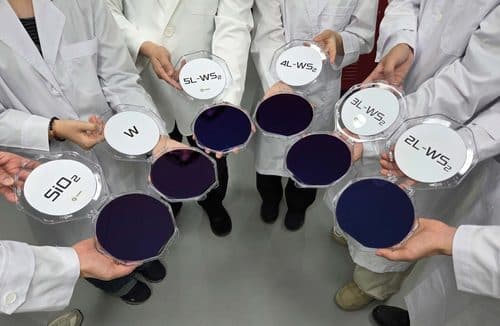
Researchers from the Korea Institute of Machinery and Materials (KIMM), in collaboration with Hanyang University, have developed a way to precisely thin an extremely thin semiconductor material and use it to build a device that combines light sensing with memory. They claim that it is the world’s first technology to precisely increase or decrease the thickness of a semiconductor material, one atomic layer at a time, uniformly across a 6-inch (15 cm) wafer-scale tungsten disulfide (WS2).
The material is extremely thin, with its thickness measured at approximately one hundred-thousandth of the thickness of a human hair. The researchers started with a material containing five layers. They developed a technique to selectively remove one layer at a time, such as from five layers to four, three and two layers.
The main limitation the researchers addressed was the difficulty of controlling the thickness of 2D semiconductor materials uniformly across a large wafer, one atomic layer at a time. They used a plasma etching process employed in semiconductor manufacturing. They started by applying plasma generated from a mixture of three gases to five-layer WS2 for 1–4 seconds, removing one atomic layer at a time. The researchers achieved a minimum semiconductor film thickness of 0.76 nm.
When the initial tungsten film has a smooth, even surface, the resulting WS2 also has a more uniform surface. On a rough surface, it was found that some layers were locally damaged and the thickness became non-uniform. The researchers utilised electron microscopy along with other analyses to observe the material at the surface and atomic layer levels.

Through this study, it becomes clear that it is possible to construct an opto-memristor based on a very thin semiconductor, WS2, which is able to sense the light and remember past light pulses. The four-layer device was capable of recognising all 16 different combinations of four on/off light pulses (4-bit input) and storing them in different states.
The scientists also performed the analysis of the device via reservoir computing. In this study, the model successfully classified five types of signal waveforms with an average accuracy of 95.8%. It might become possible to adjust the memory behaviour of the device by changing the number of atomic layers.

