




HomeElectronics NewsFast 3D Mapping For Robots In Dangerous Areas

Fast 3D Mapping For Robots In Dangerous Areas

In disaster zones, every second counts. What if a robot could map hazardous spaces in real-time, converting hundreds of images into an accurate 3D map instantly?
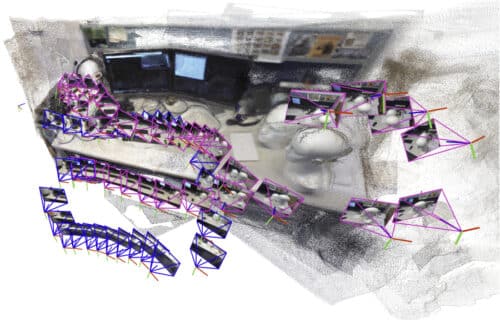
The artificial intelligence-driven system incrementally creates and aligns smaller submaps of the scene, which it stitches together to reconstruct a full 3D map, like of an office cubicle, while estimating the robot’s position in real-time. Image Credit: Courtesy of the researchers

Robots navigating disaster zones, such as partially collapsed mines, must quickly map their surroundings and determine their exact location to safely locate survivors. Existing machine-learning systems can perform this task using only onboard cameras, but they typically handle only a small number of images at a time. In real emergencies, robots must cover large areas and process thousands of images rapidly.

- Advertisement -

Researchers at MIT created a system to overcome this limitation. It generates small 3D submaps and stitches them together to form a complete map, continuously tracking the robot’s position. Unlike previous methods, it does not require calibrated cameras or expert tuning. This system operates faster, simplifies processes, and scales easily. Flexible mathematical transformations correct small distortions in each submap, ensuring accurate alignment and reducing errors to under five centimeters.

The system produces high-quality 3D reconstructions in near real-time, even from short cell phone videos, and enables robots to localize themselves in complex, crowded environments such as office corridors or industrial warehouses. Beyond search-and-rescue, it could also support VR and extended reality applications or help robots navigate warehouses efficiently.

Traditional robotic navigation relies on simultaneous localization and mapping (SLAM), where a robot simultaneously maps its environment and tracks its position. Conventional SLAM methods often fail in complex scenes or require pre-calibrated cameras. Machine-learning models improve performance but remain limited in the number of images they can handle, restricting their usefulness for large-scale or time-critical tasks.

- Advertisement -

By breaking the scene into submaps and applying AI-enhanced alignment techniques, the system efficiently processes large numbers of images, generating accurate maps and camera positions in real-time. Future work will focus on improving reliability in extremely complex scenes and deploying the system on robots operating in challenging, real-world environments.


Nidhi Agarwal
Nidhi Agarwal
Nidhi Agarwal is a Senior Technology Journalist at Electronics For You, specialising in embedded systems, development boards, and IoT cloud solutions. With a Master’s degree in Signal Processing, she combines strong technical knowledge with hands-on industry experience to deliver clear, insightful, and application-focused content. Nidhi began her career in engineering roles, working as a Product Engineer at Makerdemy, where she gained practical exposure to IoT systems, development platforms, and real-world implementation challenges. She has also worked as an IoT intern and robotics developer, building a solid foundation in hardware-software integration and emerging technologies. Before transitioning fully into technology journalism, she spent several years in academia as an Assistant Professor and Lecturer, teaching electronics and related subjects. This background reflects in her writing, which is structured, easy to understand, and highly educational for both students and professionals. At Electronics For You, Nidhi covers a wide range of topics including embedded development, cloud-connected devices, and next-generation electronics platforms. Her work focuses on simplifying complex technologies while maintaining technical accuracy, helping engineers, developers, and learners stay updated in a rapidly evolving ecosystem.

SHARE YOUR THOUGHTS & COMMENTS

EFY Prime

Unique DIY Projects

Electronics News

Truly Innovative Electronics

Latest DIY Videos

Electronics Components

Electronics Jobs

Calculators For Electronics
