

Physics-based model from the University of Michigan links ferroelectric switching behaviour with circuit simulation, enabling more accurate designs for energy-efficient memory and AI chips.
A new physics-based analytical model could make ferroelectric devices easier to design and simulate at the circuit level, addressing a long-standing gap between material physics and practical semiconductor engineering. Developed by researchers at the University of Michigan, the model predicts how ferroelectric materials respond to complex, time-varying voltage signals rather than assuming the constant voltages used by many existing approaches.
The development is particularly relevant to ferroelectric memory and emerging computing architectures, including logic-in-memory systems designed to reduce the energy and performance penalties associated with moving data between processors and memory. Ferroelectric materials can retain one of two polarisation states, allowing them to represent digital information without relying solely on conventional charge storage.
A key feature of the model is its ability to reproduce the switching process that occurs inside a ferroelectric device. Polarization does not change everywhere simultaneously. Instead, switching begins in small regions through a process known as nucleation before spreading through the material through domain growth.
The researchers combined a reverse-time-cone approach with statistical thermodynamics to model these processes while accounting for the material’s voltage history. This is important because real electronic circuits apply pulses and signals that vary in amplitude, frequency, and timing. The model can therefore capture the material’s response to changing electrical conditions and its dependence on previous states.
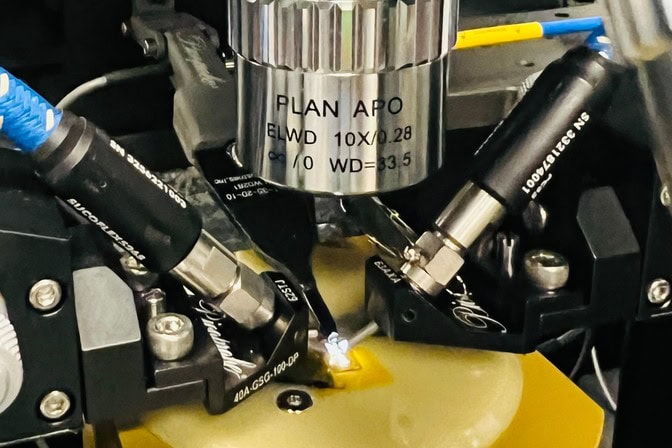
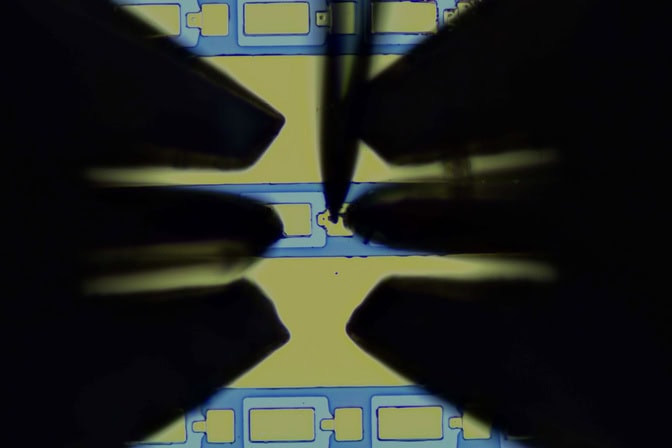
The team tested the approach using hafnium zirconium oxide (HZO), a ferroelectric material attracting attention for semiconductor applications because it can retain ferroelectric behavior at very small thicknesses and is compatible with silicon manufacturing processes. Experimental measurements from HZO devices fabricated at the University of Michigan’s Lurie Nanofabrication Facility closely matched the model using a single set of material parameters.
The researchers also reduced the physics-based approach to three key parameters, allowing it to be incorporated into SPICE, widely used circuit-simulation software. This creates a path for engineers to evaluate ferroelectric devices at circuit scale before fabrication.
For chip designers, the benefit is the ability to model large arrays of ferroelectric memory cells and estimate characteristics such as switching behavior, energy consumption, and speed during the design stage. The researchers have also made their Python-based simulation code open source, potentially lowering barriers to further development of ferroelectric computing technologies.