What if fiber sensors could spot cancer early? This system tracks disease signals in real time using light, with invasive testing reduced.
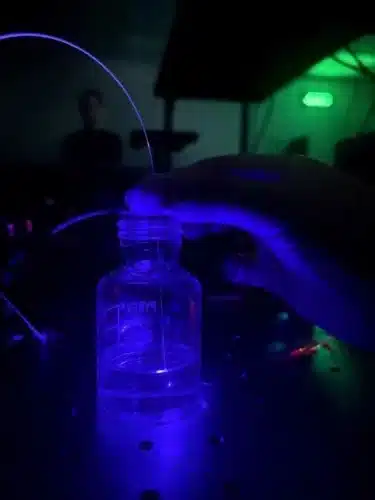
Researchers from Adelaide University’s Institute for Photonics and Advanced Sensing and the University of Stuttgart developed tiny sensors using ultrafast 3D micro-printing, which target specific biomarkers and are printed on the tip of optical fibers, allowing them to monitor multiple signals at the same time, including temperature and chemical changes.
The lead researcher stated that the breakthrough could enable next-generation medical tools capable of tracking disease, guiding treatment, and monitoring the body in real time. The sensors are designed to provide clear and reliable information about disease presence in a minimally invasive way, opening opportunities for improved healthcare, environmental monitoring, and wearable devices.
The team has spent several years developing the technology, which works by detecting molecular-level changes in the body caused by cancer using light. When molecules interact with cancer-related by-products, they emit light, and the intensity of this emission depends on the concentration of cancer cells. By placing the sensors into tissue and measuring the emitted light, the system can help determine the presence of cancer.
This development builds on existing methods that typically measure only one biomarker at a time. Measuring multiple signals simultaneously in a living system like the human body is challenging, and single-biomarker measurements often make it difficult to identify whether changes are caused by cancer or other conditions. The new approach addresses this by enabling more precise and immediate information for medical use.
Access to advanced laser printing technology is expected to support further work, including detecting additional biomarkers such as pH and oxidation-reduction changes. The team plans to develop prototypes more quickly, build more complex structures, and expand applications in the biomedical field, with future collaboration with hospitals to refine the technology and prepare it for practical use within the next decade.