A hidden threading bottleneck was slowing video encoding on powerful workstations which was later solved by a software fix. How?

AMD has contributed performance improvements to the open source video transcoding software HandBrake, addressing bottlenecks that limited performance on high core count processors. The changes, now included in HandBrake 1.11.0 and later, enable significantly better utilization of AMD Ryzen Threadripper and Threadripper PRO processors during video encoding tasks.
The improvements target content creators, video editors, and professionals who rely on CPU intensive transcoding workflows. During internal testing, AMD found that HandBrake was unable to efficiently use systems with more than 64 logical processors. In some cases, performance dropped rather than improved as additional CPU resources became available.
According to the company, two major issues were responsible. The software struggled to scale beyond 64 logical processors and divided some workloads into excessively small tasks, creating scheduling overhead that consumed processing resources. This was particularly noticeable in lower resolution video transcoding workloads.
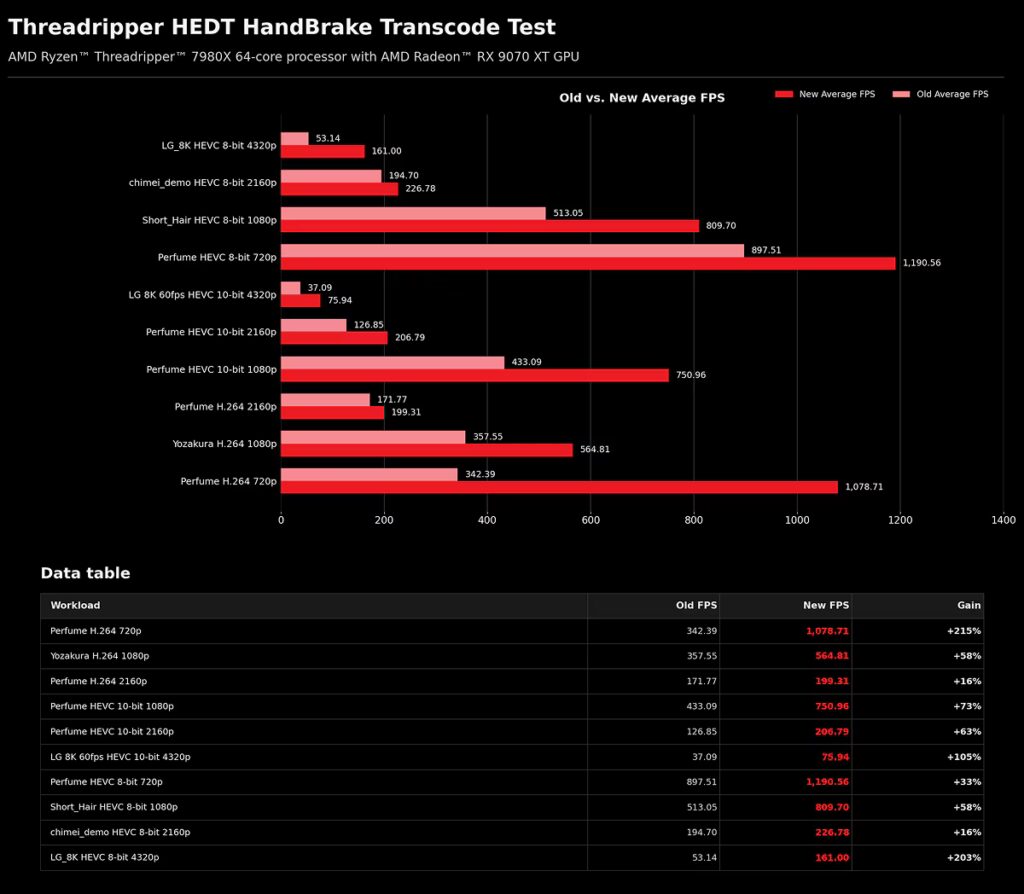
To address these limitations, AMD modified HandBrake’s thread management and job scheduling mechanisms. The updates allow the software to distribute workloads more effectively across many CPU cores, reducing overhead and improving processor utilization.
Testing conducted by AMD showed performance gains of up to 181% on a 96 core Ryzen Threadripper PRO 9995WX system and up to 215% on a 64 core Ryzen Threadripper 7980X system, depending on the workload. The largest improvements were observed in H.264 and HEVC transcoding tasks, including 8K video content.
The enhancements have been integrated into the main HandBrake codebase and are available through standard software updates.
“Video encoding remains one of the most compute intensive workflows,” says Bradley Sepos, Software Engineer and Project Co Lead at HandBrake. “The HandBrake project thanks AMD for their continued investment.”