A flash memory design stores more data in less space, improves data transfer speed, and reduces power use.
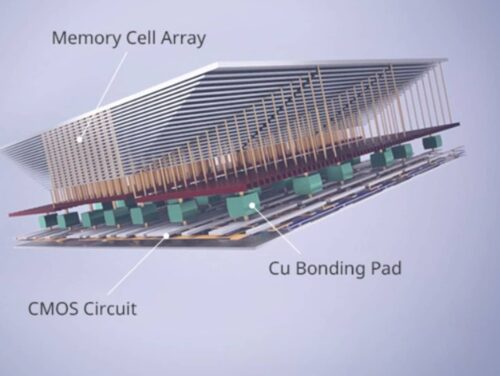
Kioxia and Sandisk have unveiled a new QLC 3D flash memory technology that increases bit density by up to 60% compared to their eighth-generation memory. It exceeds 37 Gb/mm², setting an industry benchmark for bit density, performance, and power efficiency.
The new memory is based on the companies’ CMOS directly Bonded to Array (CBA) technology. This process builds the CMOS logic and memory array on separate wafers and then bonds them together using high-precision wafer-to-wafer alignment.
The new generation also improves read and write bandwidth compared to the eighth-generation 3D flash memory. It is the first QLC 3D flash memory technology in the industry to reach a 4.8 Gb/s interface speed.
Further changes to the interface improve power efficiency during I/O data transfer. These improvements are aimed at reducing power use and cooling requirements in AI and cloud infrastructure.

Key highlights of the 10th-generation QLC 3D flash memory
- 332-layer architecture: The 332-layer design and optimized floorplan increase bit density by up to 60%, reaching more than 37 Gb/mm² compared to the eighth-generation memory.
- 4.8 Gb/s interface: The NAND interface reaches 4.8 Gb/s using Toggle DDR6.0 and the Separate Command Address (SCA) protocol.
- CBA architecture: CMOS directly Bonded to Array (CBA) technology helps increase memory density, improve performance, and support more efficient manufacturing.
- Improved power efficiency: Power Isolated Low Tapped Termination (PILTT) reduces power use during I/O data-out transfers.
Chief Technology Officer at Kioxia, Hideshi Miyajima, said, “As AI continues to underpin the advancement of society, its applications are expanding from generative AI to agent-based and physical AI, while the use of data is becoming increasingly diverse and sophisticated. QLC technology enables the efficient storage of rapidly expanding data volumes, helping deliver greater performance and scalability for AI systems. Kioxia will accelerate development toward the commercialization of its 10th-generation flash memory products incorporating QLC technology.”