The solar cells can work in wet air, stay strong after many bends, and are made without using machines that cost a lot.
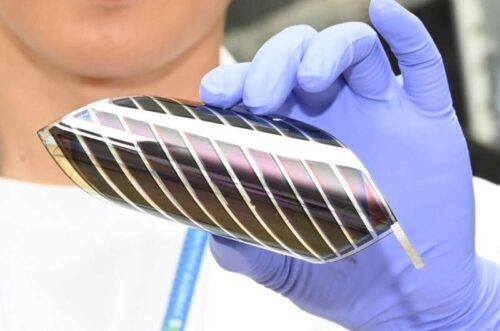
Researchers at the Korea Institute of Materials Science (KIMS) have developed a flexible perovskite solar cell material and manufacturing process that stays stable even in humid environments. The method allows high-efficiency solar cells to be produced in normal air, without the need for expensive equipment like low-humidity chambers or inert gas setups. This breakthrough is expected to reduce manufacturing costs and support commercial scalability.
The new technology also shows one of the highest levels of mechanical durability among flexible solar cells developed to date. It has already been successfully applied to large-area continuous production processes, proving its potential for mass manufacturing. These features make the solar cells suitable for rollable panels, wearable electronics, and vehicle-integrated solar applications.
In performance tests, the flexible perovskite cells kept over 85% of their efficiency after 2,800 hours of operation. They also remained stable after 10,000 bending cycles and extreme sliding tests, demonstrating strong mechanical strength. The cells operated reliably even at humidity levels of up to 50%.
To overcome perovskite’s known sensitivity to moisture, the researchers placed a layer of two-dimensional (2D) perovskite material above and below the main light-absorbing layer. This structure helped block defects and shield the active layer from environmental damage.
Perovskite is seen as a promising alternative to silicon in solar technology due to its strong light absorption and lower material cost. However, issues with moisture stability and difficulty in making flexible versions have slowed commercial adoption.
The project received support from both domestic and international collaborators, including the University of Fribourg in Switzerland, Pusan National University, and Pukyong National University. Going forward, the KIMS team aims to further develop perovskite solar materials that are both durable and cost-effective, and to refine large-area production techniques to move closer to full commercialization.