A carbon film helps fill and smooth chip structures, supporting patterning in logic, memory, and packaging processes.
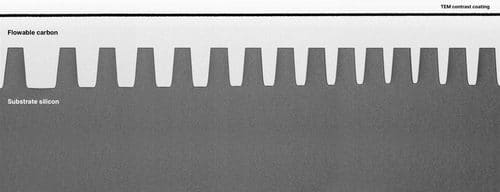
ASM has introduced XP8 Vertos Flowable Carbon to address the growing patterning complexity in advanced logic and memory devices. The material is designed to fill, planarise, and support patterning of advanced features through a single integrated process.
The film is aimed at semiconductor structures where increasingly narrow, deep, and complex features require tighter control of filling, surface topography, and pattern fidelity. By combining gap-fill performance with planarisation, Flowable Carbon is intended to simplify process integration while providing the topography control needed for advanced patterning.
Advanced logic and memory structures increasingly depend on the ability to fill, planarise, and pattern narrow and deep features with precise control. As device architectures become more complex, these requirements are becoming harder to manage within conventional manufacturing flows.
Flowable Carbon combines gap-fill and planarisation capabilities within one material and process approach. Instead of treating filling and planarisation as separate requirements, the material is designed to address both in an integrated flow.
This capability is intended to help manufacturers manage wafer topography before subsequent patterning steps. Controlling variations in surface height becomes increasingly important when a wafer contains structures with different dimensions and pattern densities, as small variations can affect downstream process margins, pattern fidelity, yield, and manufacturing efficiency.
The material provides full gap fill and self-planarisation for complex structures. It can also support controlled partial-fill schemes through integrated recess processes. The partial-fill capability allows manufacturers to control the amount of film remaining in a structure and adjust its height and profile according to the process requirement.
These capabilities are relevant to several areas of semiconductor manufacturing. In advanced logic, Flowable Carbon can support increasingly complex patterning and hard-mask schemes. In memory manufacturing, including DRAM and 3D NAND, it provides an approach for structures with very high aspect ratios, where filling and maintaining the required surface profile can be challenging.
The material is also being explored for applications in advanced packaging and wafer-level integration, where complex three-dimensional structures create additional requirements for material deposition, filling, and surface control.