

The M9B project implements a RISC-V computer on an FPGA development board, combining HDMI video, USB peripherals, memory and support for classic PC games.
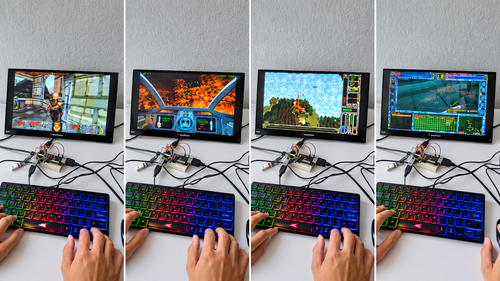
Building a computer using an FPGA does not necessarily involve creating the whole computer processor and peripherals from scratch. The open-source M9B computer built by the-parts-bin is an example of how a computer using RISC-V architecture can be constructed in a small FPGA board with video output, audio, storage, and USB support.

The project runs on the Sipeed Tang Nano 9K, an FPGA development board based on the Gowin GW1NR-9 device. At its core is a VexiiRiscv processor, an open-source RISC-V CPU implemented within the FPGA. The processor operates at 36MHz and uses 8MB of on-package PSRAM for memory.
Unlike conventional microcontroller projects, where the processor architecture is fixed by the selected chip, an FPGA-based implementation allows developers to work with the processor’s hardware description and supporting logic.
HDMI video output with 720 × 480 resolution as well as audio output with 48kHz is provided by the computer. Two USB ports provide connections for keyboard and mouse, whereas the microSD card is used for storage purposes. These interfaces allow the board to operate as a compact computer rather than simply serving as a processor development platform.

One of the project’s notable features is its ability to run classic PC games. Its software support includes Doom, Descent, Tyrian, System Shock and Ultima VII. The repository also includes boot firmware, runtime components and software required to prepare the system’s storage card.
For developers interested in open-source processor architectures, the project provides an opportunity to examine how a RISC-V CPU, memory, display interfaces and peripheral controllers can be integrated within an FPGA. The hardware description and supporting software can also serve as reference material for experimenting with FPGA-based computing systems.
With the combination of an FPGA-based RISC-V computation system with familiar interfaces from PCs and games, M9B is a readily available model that shows how open hardware and software can be integrated into a compact computer system.
For more information, click here.