




New sub-terahertz graphene receivers promise ultra-fast, low-power wireless systems for next-generation electronics.
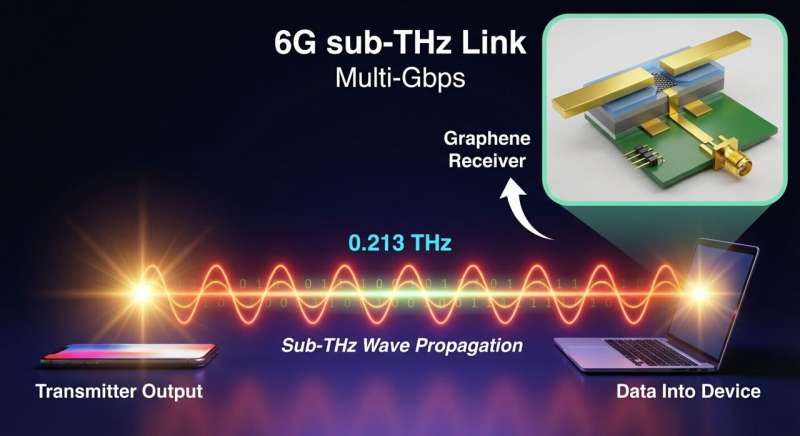
As global data demand accelerates beyond 5G capabilities, 6G is expected to deliver terabit-per-second speeds, ultra-low latency, and massive connectivity. However, achieving this requires new hardware capable of operating at sub-THz frequencies, where conventional electronic components struggle with efficiency, size, and power constraints.
ICFO researchers, Dr Karuppasamy Pandian Soundarapandian, Dr Sebastián Castilla, and Dr Simone Marconi, led by ICREA Prof. Frank Koppens, have demonstrated graphene-based receivers that enable energy-efficient 6G hardware, addressing one of the biggest bottlenecks in next-generation wireless electronicshigh-frequency signal detection with low power consumption. The breakthrough marks a significant step toward practical 6G systems operating in the sub-terahertz (sub-THz) spectrum.
The newly developed graphene receivers address these challenges by combining compact design with high sensitivity and low energy requirements. Unlike traditional semiconductor-based receivers, graphene’s exceptional electrical conductivity and carrier mobility enable efficient detection of high-frequency signals without complex architectures or excessive power draw. This makes the technology particularly suitable for integration into consumer electronics, IoT devices, and high-speed communication modules.
In experimental demonstrations, the receivers successfully operated in the sub-THz regime, validating their capability to process high-bandwidth signals essential for 6G communication. The devices also offer a smaller footprint and compatibility with scalable fabrication approaches, improving their viability for mass deployment in future wireless systems.
The development is part of a broader industry shift toward advanced materials such as graphene to overcome the physical limitations of silicon-based electronics. Graphene’s ability to support faster data transmission while reducing energy consumption positions it as a key enabler for sustainable telecom infrastructure and next-generation chip design.
Looking ahead, graphene-based receivers could play a critical role in enabling applications such as high-speed device-to-device communication, advanced sensing, and edge computing. While further work is needed to scale the technology and integrate it into commercial platforms, the results highlight a clear pathway toward energy-efficient, high-performance 6G hardware.


