




A coupled inductor reduces component count, saves board space, improves EMC, and helps build DC-DC converters.
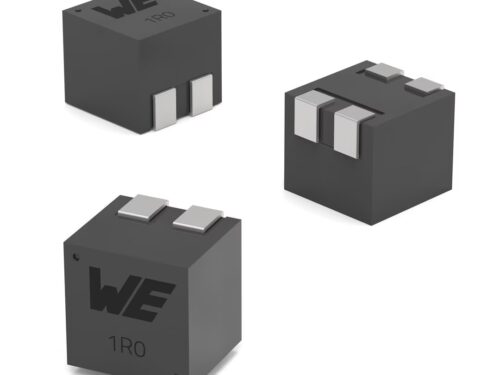
Würth Elektronik has introduced the WE-MCRI 1090HL (High Leakage), a new coupled inductor designed for SEPIC, ZETA, and Ćuk DC-DC converter applications. Unlike conventional coupled inductors that aim to minimize leakage inductance, the new component uses controlled leakage inductance to improve filtering and electromagnetic compatibility (EMC). This approach helps simplify converter designs while reducing the number of external components required.
The 1090HL is a molded SMT coupled inductor measuring 11 × 10 × 9 mm. It reduces ripple current while requiring a lower inductance value than conventional designs. By replacing two separate inductors with a single coupled inductor, it cuts PCB space, lowers component count, and reduces system cost. It also enables the use of a smaller AC coupling capacitor without affecting converter efficiency, allowing designers to build more compact power supplies.
The component features a magnetically shielded composite core that provides high saturation current, soft saturation characteristics, and stable electrical performance across a wide operating temperature range of -40°C to +125°C. It has a 1:1 turns ratio and is suitable not only for SEPIC, ZETA, and Ćuk converters but also for other power conversion topologies, including buck, boost, flyback, and switching regulators with a secondary unregulated output.
To help designers achieve predictable circuit performance, Würth Elektronik specifies tolerances for both the coupling factor and leakage inductance, parameters that are often not defined by other manufacturers. The company also provides design resources, including LTspice, PSpice, and ADS simulation models, along with application notes and technical support for converter design and EMC optimization.
Click here for the original announcement.


