A neuromorphic sensor can detect humidity, process signals, and store data in one device. It uses less energy and can be used in edge computing, wearables, and monitoring systems.
A humidity-responsive neuromorphic sensor has been developed that can sense, process, and store information within a single device. By combining these functions, it reduces energy use and avoids continuous data transfer, which is useful for edge computing and artificial intelligence systems.
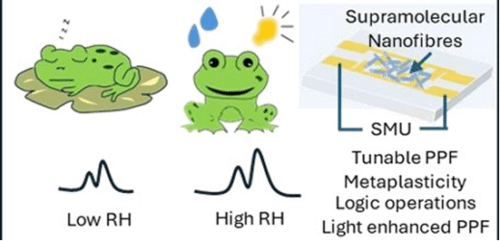
Researchers at the Jawaharlal Nehru Centre for Advanced Scientific Research built the device using one-dimensional supramolecular nanofibres. The work was reported in the Journal of Materials Chemistry C. The design is based on biological systems, taking cues from organisms such as the cricket frog, where neural responses change with moisture and light.
The device integrates sensing, memory, and processing in one platform, unlike many existing neuromorphic systems that use separate sensing units and memristive elements. This separation in current designs increases energy use and adds data transfer overhead. In biological systems, sensing and processing occur together, improving efficiency. Replicating this in hardware is important for building adaptive electronic systems.
The supramolecular nanofibres were grown from a charge transfer complex formed between donor and acceptor molecules. These nanofibres were drop coated onto interdigitated gold electrodes on a glass substrate to form the active device layer. The device was placed in a humidity-controlled chamber, where relative humidity was regulated using humidified nitrogen flow. Humidity pulses of different strengths and time intervals were applied, and electrical measurements were performed to study synaptic responses such as facilitation, depression, and metaplasticity, along with basic logic operations.

The device detects changes in surrounding moisture through variations in current response. It also shows the ability to temporarily retain information from earlier humidity exposure, indicating memory behaviour. Its response changes with light as well, similar to certain amphibians whose activity depends on both moisture and daylight. By handling sensing and processing at the same time, the device operates closer to biological systems.
This work demonstrates the use of humidity as the main input to replicate synaptic behaviour in a neuromorphic device. Such systems can be used in environmental monitoring, healthcare devices, wearable sensors, and edge computing applications in artificial intelligence and the Internet of Things, where lower energy use and adaptive response are important.