Power devices are designed for electric vehicle compressors, heaters, and industrial inverters to reduce power loss and support smaller systems.
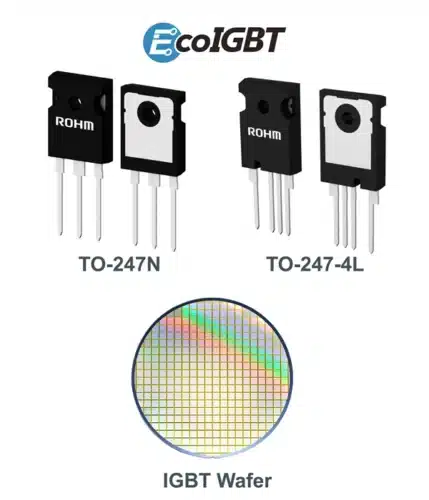
ROHM has developed its 4th-generation 650V IGBTs for applications including automotive electric compressors, high-voltage (HV) heaters, and motor and compressor inverters used in industrial equipment.
The automotive-grade devices have a collector-emitter saturation voltage (VCE(sat)) of 1.55V, which helps reduce conduction losses. They also offer a short-circuit withstand time of 7µs at a junction temperature (Tj) of 25°C and comply with the AEC-Q101 automotive reliability standard.
As electric vehicles move toward higher-voltage architectures, silicon carbide (SiC) devices are increasingly used in high-power systems such as traction inverters. However, 650V IGBTs remain used in lower-power auxiliary applications, including electric compressors and HV heaters. Silicon IGBTs are also used in industrial motor and compressor inverter systems.
These applications require power devices that limit energy losses while supporting smaller system designs. Inverter and heater circuits also need sufficient short-circuit tolerance to allow time for overcurrent conditions to be detected and interrupted.
ROHM addressed these requirements by redesigning the IGBT structure, including its manufacturing process and edge termination structure. The new structure increases current density while reducing both conduction and switching losses.
The initial lineup comprises 12 products in the TO-247N package under the RGAxxTS65HR and RGAxxTS65EHR series. Another 10 bare wafer products are available under the SG83xxWN series. ROHM is also developing 12 products in the TO-247-4L package under the RGAxxTR65HR and RGAxxTR65EHR series.
ROHM plans to expand the lineup in existing packages and develop compact surface-mount versions using the TO-263L package and top-side cooling (TSC) packages. The company is also continuing development of IGBTs for automotive and industrial applications, with further focus on reducing power losses and enabling smaller system designs.
Click here for the original announcement.