




Could drones stay airborne without landing to recharge? Researchers have demonstrated a laser-powered receiver that converts light into usable electricity.
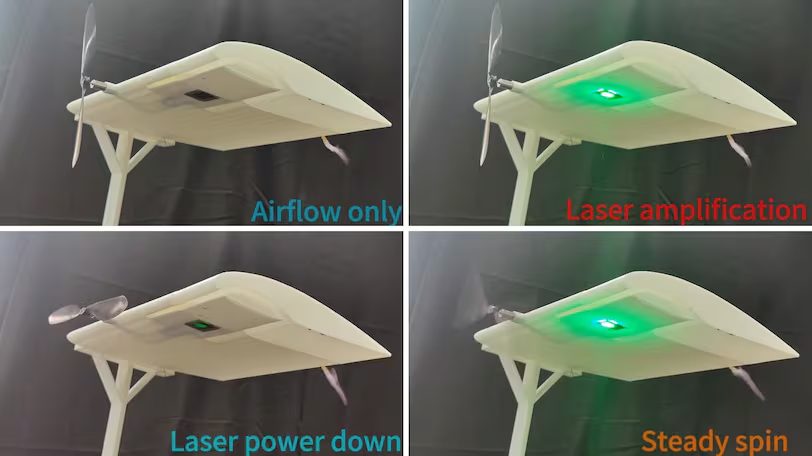
Researchers at the Civil Aviation University of China have developed a laser-powered energy receiver that could enable drones to recharge while flying, potentially extending mission durations without requiring battery replacement or landing. The prototype, described in the journal Matter and Light, converts laser energy into electricity using a receiver specifically designed for laser illumination rather than sunlight.
Battery life remains one of the main limitations for drones used in applications such as infrastructure inspection, disaster response and package delivery. The proposed approach involves directing a laser beam towards a receiver mounted beneath or on the wings of a drone, allowing the aircraft to generate electrical power during flight. If further developed, the technology could reduce operational downtime and support longer-duration missions.
The receiver combines a perovskite-based photovoltaic layer with a thermoelectric layer that recovers part of the heat generated by the incoming laser. Since high-power lasers significantly increase device temperature, the research team incorporated specialised nanocrystals that act as a thermal barrier, slowing heat transfer and improving power conversion efficiency. During laboratory testing, the prototype reached temperatures between 80°C and 90°C, highlighting thermal management as a key engineering challenge.
In static experiments using a green laser, the receiver converted 38.49% of the incoming laser energy into electricity, generating enough power to operate a propeller while maintaining a cooler surface on one side of the device. The researchers say the next stage will involve integrating the receiver into a lightweight drone and evaluating its performance during outdoor flight. They also plan to address challenges related to accurately tracking moving aircraft with laser beams and ensuring safe operation.
“Previous studies largely focused on the materials or the device itself. We wanted to think beyond the laboratory, to how the system could actually be integrated into an aircraft, cooled during operation, and made compatible with flight. It isn’t just a materials science problem—it’s an engineering one,” says Jianhua Han, senior author and researcher at the civil aviation University of China.


