Could microscopic robots clean biological samples without conventional motors? Researchers have demonstrated light-driven machines that capture and relocate bacteria.
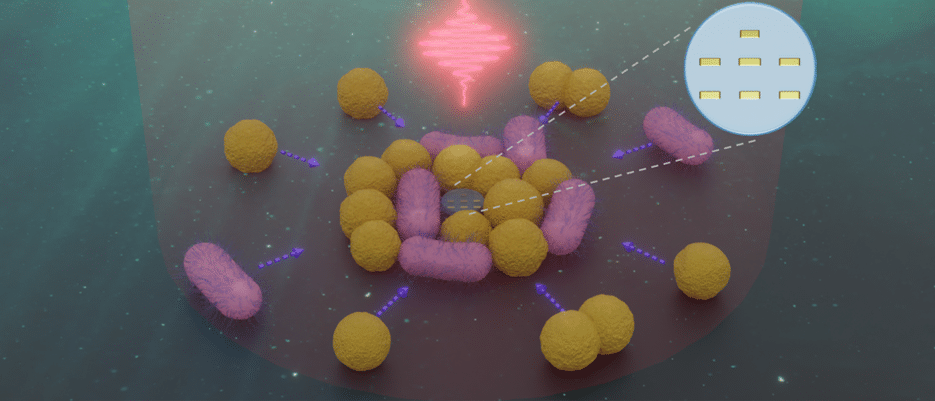
Researchers at Julius-Maximilians-Universität Würzburg (JMU) have developed light-driven nanorobots capable of selectively capturing, transporting, and releasing bacteria in aqueous environments. Measuring less than one micrometre, the robots are around 50 times smaller than the diameter of a human hair.
The work could provide a way to manipulate biological objects at a scale where conventional robotic systems cannot operate. By collecting bacteria and depositing them at defined locations, the nanorobots could support controlled experiments in microbiology and biomedical research.
The robots use photon recoil for propulsion. Their plasmonic nanoantennas absorb incident light and re-emit photons directionally, generating a recoil force that moves the lightweight structures. The researchers simplified the design to reduce the size below one micrometre while retaining photon-based propulsion.
Steering is achieved by controlling the polarisation of the incident light. Nanoscale antenna wires embedded in the robot align with the light’s polarisation direction, allowing researchers to control the robot’s orientation while propulsion continues through photon recoil. The robots can also execute rapid 90-degree turns, enabling them to scan areas of a sample.
In laboratory demonstrations, the nanorobots captured, transported, and released multiple bacteria. They remained manoeuvrable while carrying larger bacterial clusters, although their speed decreased during transport. This demonstrates that the system can actively manipulate microorganisms rather than merely observe them.
The researchers see potential applications in microbiology, biomedical research, and targeted manipulation at the microscale. “In essence, we have built a light-driven nanorobot that can track down and collect bacteria,” says Jin Qin, Lead Experimental Scientist at Julius-Maximilians-Universität Würzburg.