

A bird-inspired drone developed by researchers at TU Delft can use tactile sensors to detect, grip, and perch on branches. By relying on touch when vision is unreliable, the technology could enable drones to monitor forests and other complex environments for longer periods.
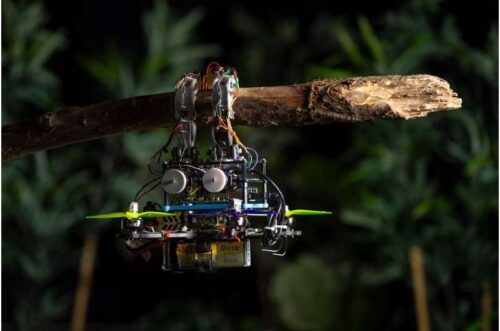
Drones are useful for monitoring difficult environments, but continuously hovering consumes battery power, while cameras can struggle in cluttered surroundings such as forests. Researchers at TU Delft have developed a drone that takes inspiration from birds by using a robotic gripping mechanism and tactile sensors to land on and hold branches.
The drone’s gripper is equipped with soft tactile sensors that detect contact with its surroundings. Instead of relying entirely on cameras to determine the position, orientation, and size of a branch, the drone gradually builds a more accurate picture through physical contact.
Each sensor provides simple information about whether something is present. When the individual sensor readings are combined with knowledge of the gripper’s shape, the drone can determine where a branch is and how it is oriented. This allows the system to correct errors in visual perception while approaching and gripping the branch.
Flight experiments showed that the tactile approach remained reliable even when conventional vision-based estimates of the target were inaccurate. Once securely attached to a branch, the drone can rest rather than continuously hover, potentially extending its operating time.

The researchers believe the technology could be useful for forest-canopy monitoring, inspections of cluttered industrial structures, and other environments where cameras or motion-capture systems are unreliable.
More broadly, the work presents touch not as a problem for aerial robots, but as a valuable source of information. Future drones could use tactile sensing to navigate environments and find suitable places to land—even when they cannot fully see their surroundings.