





Chinese researchers have developed a lithium battery with over 600 Wh/kg energy density—double that of Tesla’s best cells, the design promises longer range, safer operation, and new possibilities for EVs, renewable grids, and consumer electronics.
Researchers in China have unveiled a lithium battery design that more than doubles the energy density of today’s best electric vehicle (EV) batteries, a breakthrough that could transform performance, range, and safety standards across the sector.The team at Tianjin University reports achieving 604.2 watt-hours per kilogram (Wh/kg)—a leap from Tesla’s current benchmark of around 300 Wh/kg. If successfully scaled, the innovation could enable EVs to travel significantly farther on a single charge while reducing battery size and weight.
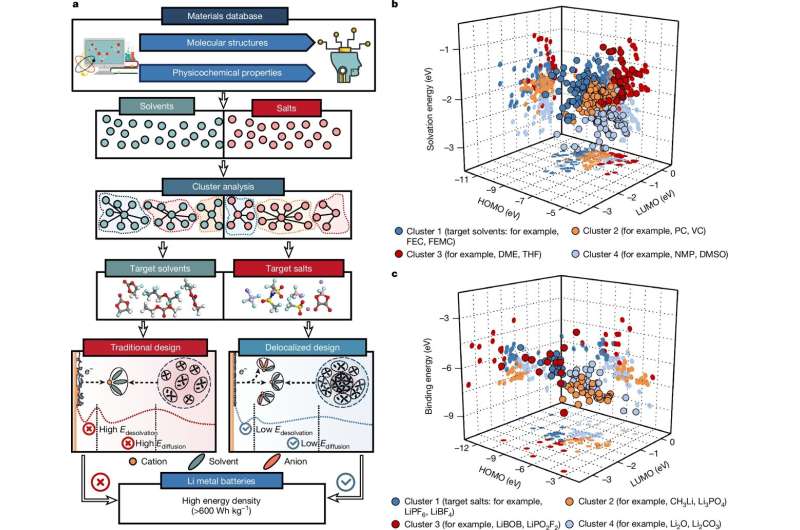
Conventional lithium batteries rely on liquid electrolytes to transport ions. Over time, these electrolytes tend to form rigid, structured layers around lithium ions, hampering movement and degrading efficiency. This bottleneck has capped performance improvements despite years of optimization.The Tianjin team addressed this by re-engineering the electrolyte at the molecular level. Their “delocalized electrolyte design” disrupts the rigid structures, creating a disordered environment that allows ions to flow freely. The result is enhanced stability, faster transport, and more efficient energy transfer.
Beyond Density
Alongside its record-setting density, the prototype demonstrated durability across 100+ charging cycles while maintaining structural integrity. Safety tests showed the new electrolyte did not ignite under open flame, addressing one of the most pressing concerns in lithium battery design. It also performed reliably at -60°C, where conventional electrolytes typically freeze.
For now, the system remains a proof-of-concept confined to laboratory validation. Commercial deployment will require extensive testing under real-world conditions, as well as manufacturing solutions to produce the electrolyte at scale.
Still, the implications are far-reaching. In EVs, lighter and longer-lasting batteries could extend driving ranges and reduce charging time. Beyond transport, the technology could advance renewable energy storage and create safer, higher-capacity batteries for consumer electronics and industrial applications. If this approach fulfills its promise outside the lab, it could mark one of the most important shifts in battery science in decades—reshaping how vehicles, grids, and devices are powered.
