A new Hawaii-based HPC system combines 74 GPUs, 19.2TB memory, and liquid cooling to accelerate AI-driven analysis for space awareness, modelling, simulation, and research.
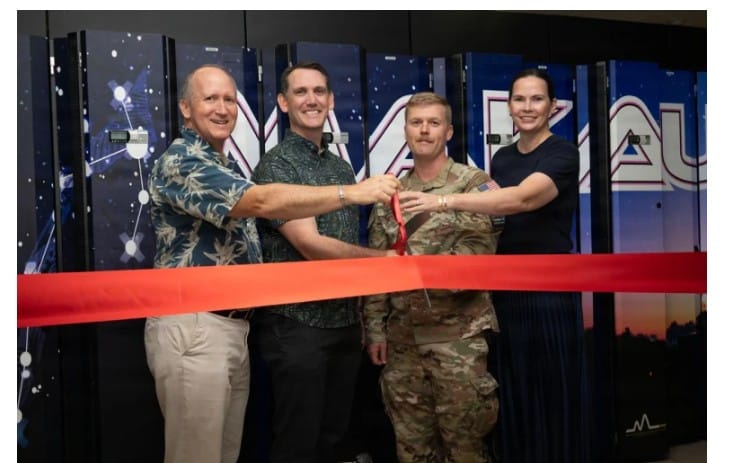
The Maui High Performance Computing Centre (MHPCC) has unveiled Makau, a new high-performance computing system designed to handle data-intensive research for the U.S. Department of Defence. The six-cabinet machine is built around Hewlett Packard Enterprise’s Cray XD2000 platform and delivers up to 2.64 petaflops of peak computing performance.
It has 74 enterprise-grade graphics processing units (GPUs) and 19.2 terabytes of usable memory, giving researchers substantial parallel-processing and data-handling capacity. The system uses liquid-cooled rear-door heat exchangers to manage the thermal load generated by its compute hardware, an approach increasingly used in dense HPC installations where conventional air cooling becomes less practical.
The machine is intended to support three major areas at MHPCC: space domain awareness, cyber operations, and digital engineering, modelling, simulation, and analysis. These workloads can involve processing large datasets, running computational models, and analysing complex simulations that would otherwise require significantly longer processing times.
A major focus is the use of artificial intelligence and machine learning alongside conventional high-performance computing (HPC) workloads. According to the team, machine-learning models can combine information from multiple data sources to produce a more coherent picture for analysis. The centre says Makau is intended to reduce some data-processing tasks from timescales measured in weeks to seconds, although actual performance will depend on the workload and software being executed.
The system also highlights the growing convergence of GPU computing, AI and simulation in specialised research environments. Instead of treating artificial intelligence (AI) as a separate workload, modern HPC platforms increasingly combine accelerated computing with large memory capacity to process and interpret complex datasets.
Beyond the hardware installation, the centre says the project is supporting local technical employment and partnerships, with MHPCC employing more than 45 professionals and continuing to recruit. For electronics and computing engineers, Makau illustrates how high-density accelerator hardware and advanced cooling are becoming central to systems built for increasingly demanding AI and scientific-computing workloads.