




A new method helps blue perovskite LEDs last longer and work better, bringing full-color displays closer to use.
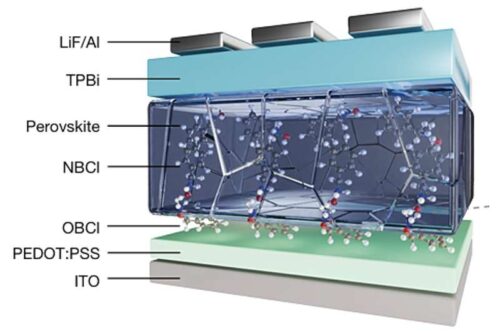
Perovskite LEDs can already produce bright red and green light, but making stable blue LEDs has remained a major challenge. Researchers from Shanghai University have now developed a new method to produce blue perovskite LEDs that are brighter, more stable, and last longer than earlier versions.
Perovskites are crystal materials whose light color can be changed by adjusting their chemical composition. They can also be made using solution-based processes, making them less expensive to manufacture than many other LED materials.
Blue light has been difficult to achieve because it requires a larger energy gap inside the material. This means the LED needs a higher operating voltage, which puts more stress on the crystal and causes it to break down faster. As a result, blue perovskite LEDs have generally been less efficient and have had a shorter lifetime than red and green versions.
To solve this problem, the researchers used two related molecules called OBCl and NBCl. One molecule was placed between the perovskite layer and the charge-transport layer, while the other was added directly into the perovskite crystal.
Unlike similar molecules used earlier, these two molecules can both donate and accept hydrogen atoms, allowing them to form more hydrogen bonds inside the crystal and at its interface. These bonds help strengthen the crystal structure, improve charge movement, and reduce the energy needed for the LED to operate.
Using this method, the researchers achieved an external quantum efficiency of 16.8% for pure-blue LEDs and 22.0% for deep-blue LEDs, showing better performance than many earlier designs.
The LEDs also operated for several hundred minutes, improving on previous deep-blue perovskite LEDs. However, the lifetime is still below what is needed for commercial display applications.
The researchers believe the same hydrogen-bonding approach could also improve the performance of other perovskite-based devices, including solar cells and sensors.


