A research team from Pusan National University (PNU), has developed an innovative two-dimensional nanostructured Fano resonant colorimetric sensor (nFRCS), significantly advancing the field of environmental monitoring.
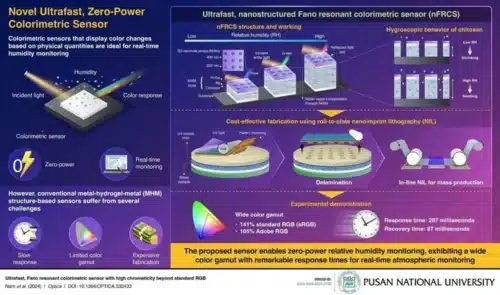
Colorimetric sensors developed by researchers of PNU, led by Gil Ju Lee, Associate Professor, PNU indicate environmental changes by shifting colours visible to the naked eye, crucial in applications requiring real-time monitoring of conditions such as humidity. These sensors are prized for their ability to function without requiring external power or complex equipment. Target users for this sensor would likely include manufacturers of packaging for perishable goods, museum conservators, and even smart display developers, as this technology offers them a powerful tool to improve efficiency and quality control.
To achieve optimal performance, colorimetric sensors must exhibit quick responsiveness, maintain a stable colour-humidity relationship, and display a broad colour spectrum. Conventional sensors, those utilizing metal-hydrogel-metal (MHM) structures with Fabry-Pérot resonance, have been used due to their simplicity and versatility. These designs generate colour by altering the thickness of a hydrogel cavity. However, traditional approaches face limitations, including slow responsiveness and restricted colour range.
The research team tackled these challenges by developing a two-dimensional nanostructured sensor that incorporates nanohole arrays. These arrays, according to Associate Professor Lee, utilize “Fano resonance and plasmonic resonances, significantly enhancing color gamut by controlling the reflectance spectrum from subtractive coloration to additive coloration.” This innovation enables the sensor to cover a wider color spectrum and improve its responsiveness.
The nFRCS design consists of an MHM structure made from layers of silver and chitosan, coated with a porous germanium (Pr-Ge) layer. This germanium layer converts the Fabry-Pérot resonator into a Fano resonator, leading to improved color representation. The incorporation of nanohole arrays also provides a pathway for water vapor to reach the chitosan, allowing the sensor to shift colors based on humidity changes.
Tests demonstrated the sensor’s superior color gamut, covering 141% of sRGB and 105% of Adobe RGB, along with impressive responsiveness, with response and recovery times of 287 and 87 milliseconds, respectively. As Dr. Lee explained, the sensor’s potential applications extend beyond humidity sensing: “The nFRCS can also serve as health monitoring devices, intelligent displays, and interior materials, reacting to external stimuli by generating distinct color shifts.”
This development represents a significant step forward in real-time environmental monitoring without requiring external power.