




A new rack-scale AI platform combines high-density GPUs, CPUs, open software and networking to accelerate inference, HPC and enterprise AI while improving deployment efficiency and scalability.
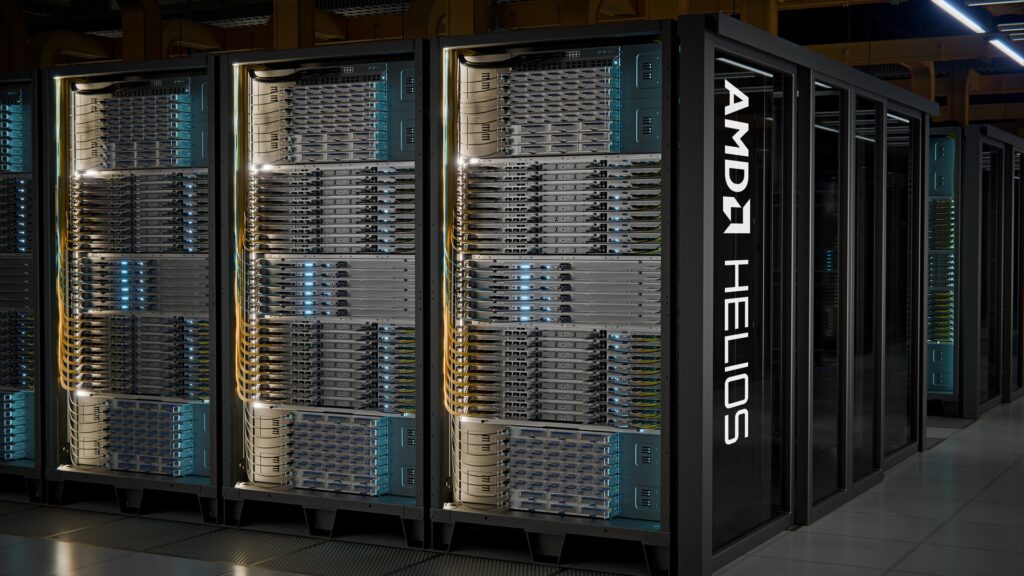
AMD has introduced the Helios AI Rackscale Solution, its latest AI infrastructure platform built around the AMD Instinct MI455X GPUs and 6th Gen AMD EPYC “Venice” processors, targeting hyperscale AI inference, enterprise AI and high-performance computing (HPC). Designed for the growing demand for agentic AI and inference workloads, the platform integrates compute, networking and software into a single rack-scale architecture aimed at improving deployment efficiency while reducing inference costs.
At the core of the system are 72 AMD Instinct MI455X GPUs paired with 18 6th Gen EPYC CPUs, interconnected using AMD Pensando networking and supported by the ROCm open software platform. According to the company, this architecture delivers up to 30% more inference tokens per dollar than competing rack-scale AI systems, enabling higher throughput for large language models and generative AI workloads.
The platform is designed to support a broad range of AI applications, from frontier model training and inference to enterprise AI services and scientific computing. The accompanying 6th Gen EPYC processors provide high core density, memory bandwidth and per-core performance to efficiently feed AI accelerators, while the Instinct MI455X GPUs are claimed to deliver 34× higher token throughput than the previous-generation MI355X for AI inference tasks.
The key features are:
- Supports up to 72 AI GPUs and 18 server CPUs in one rack
- Open ROCm software ecosystem with AI-assisted development tools
- Integrated high-speed scale-up and scale-out networking
- Multi-architecture platform combining CPU, GPU, NPU and FPGA technologies
- Roadmap extends annual AI infrastructure innovations through 2030
To simplify AI software development, the company has also introduced ROCm.ai, an AI-assisted GPU programming platform that integrates with coding tools such as Claude, Codex and Cursor. The software supports major open-source AI frameworks including PyTorch, Hugging Face, vLLM and SGLang, enabling developers to optimise applications for the company’s hardware with reduced development effort.
The Helios platform is intended for deployment in cloud data centres, AI research facilities, enterprise AI infrastructure and HPC environments. It has already been selected by several AI organisations and cloud providers for large-scale deployments, while systems based on the platform will be available through multiple OEM partners. The company has also outlined future Helios generations alongside upcoming EPYC processors and Instinct GPUs, indicating a continued focus on scaling AI infrastructure over the coming years.
Click here for the original announcement.

