

Researchers developed two molecular engineering techniques that significantly improve electrical conductivity and charge transport, advancing flexible organic electronics for sensors, displays and wearable devices.
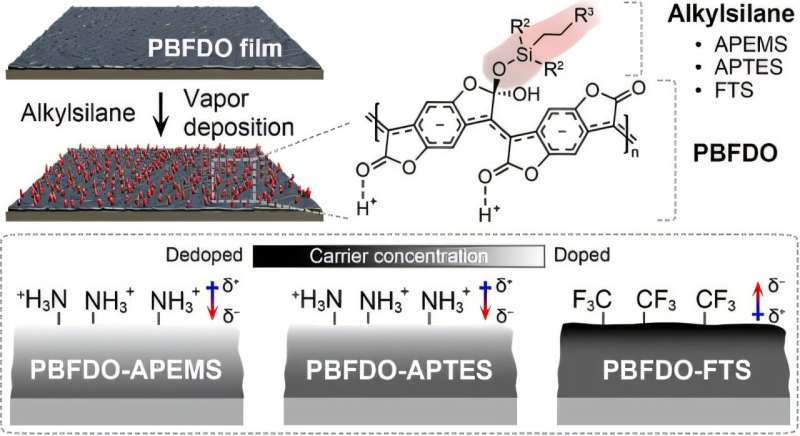
Researchers at Sungkyunkwan University have developed two complementary molecular engineering techniques that improve the electrical performance of organic electronic materials. Published in the Journal of the American Chemical Society and Nature Communications, the studies demonstrate new ways to increase charge generation and charge transport, addressing two longstanding limitations of organic semiconductors.
The first study focused on increasing the number of charge carriers within a conducting polymer. By covalently attaching polar aminoalkylsilane molecules to the n-type conducting polymer PBFDO, the researchers generated electrons without relying heavily on conventional external dopants. The approach increased the material’s electrical conductivity to more than 3,000 S cm⁻¹ while achieving a doping efficiency close to the theoretical limit, with approximately 1.79 free electrons generated per polymer repeat unit.
The second study tackled charge transport by introducing a molecular bridge structure into a two-dimensional covalent organic framework (2D COF). A thin conducting polymer coating connected charge pathways interrupted by the polycrystalline structure, enabling electrons to move more efficiently between separated crystal regions.
According to the researchers, the optimised COF–conducting polymer heterostructure delivered a 109-fold improvement in electrical conductivity compared with a single COF thin film and around a tenfold improvement over a standalone conducting polymer film. The team also fabricated a uniform thin film across a 2-inch wafer, demonstrating the approach’s potential for scalable manufacturing.
When tested as a nitrogen dioxide gas sensor, the material detected concentrations as low as 74 parts per billion with a response time of around 20 seconds, highlighting its suitability for high-performance sensing applications.
The researchers believe the two molecular design strategies provide a foundation for next-generation organic electronic devices, including flexible displays, wearable electronics and advanced sensors. They also plan to expand the work by developing heterojunction structures and exploring charge states as a new information-processing function in future electronic systems.