

A robot powered only by light completed 188 continuous jumps without electronics, carrying 1,700 times its weight using material response alone.
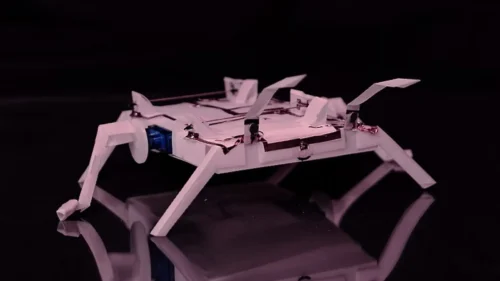
Researchers at University of California, Davis have developed an insect-scale robot powered only by light that completed 188 continuous jumps with no electronics, battery, motor, chips, or wires. In testing, it also carried up to 1,700 times its own body weight, about 300 milligrams, without loss of function.
The soft machine bends, snaps, and resets automatically. It runs entirely on material physics. Its structure handles sensing, actuation, and reset through geometry and material response alone.
The robot is built mainly from liquid crystal elastomers, a rubber-like material that changes shape when exposed to light. When illuminated, the material contracts and bends a curved beam structure, storing elastic strain energy. Once it reaches a critical point, snap-through instability occurs and the stored energy releases suddenly, pushing the robot into the air.
As it jumps, the robot creates a shadow that blocks the light source. The material cools and returns to its original shape. When exposed to light again, the cycle repeats. This self-shadowing effect acts as a built-in control system, removing the need for circuits or onboard processors.
The team initially expected the robot to jump only a few times under continuous illumination. Instead, it continued moving, completing 188 uninterrupted jumps during testing.
The work was co-authored by Wenzhong Yan from the Department of Mechanical and Aerospace Engineering at the university. His research centers on soft robotics and mechanical intelligence, where materials are designed to perform tasks usually handled by electronics. During his Ph.D., he developed folding robots that achieved autonomous behavior without computer chips, combining sensing, control, and actuation within the structure.
The light-powered robot follows this same approach. Instead of programming movement, the team designed geometry and material properties to create repeated motion.
Researchers are exploring practical uses. One proposed application is wildfire monitoring. The robots could carry sensors and move across terrain by continuously jumping. Once smoke or flame is detected, a signal could be sent to monitoring systems, forming a dynamic, distributed environmental network.
Such robots could also operate in collapsed buildings, radioactive areas, or narrow underground spaces where conventional machines cannot easily function.
The team is also studying adaptive wearables that change stiffness when needed, shifting between rigid support and flexible comfort depending on conditions.