

Researchers have created a precise molecular synthesis method enabling tailored organic semiconductor structures, potentially improving flexible electronics, transistors and next-generation functional materials.
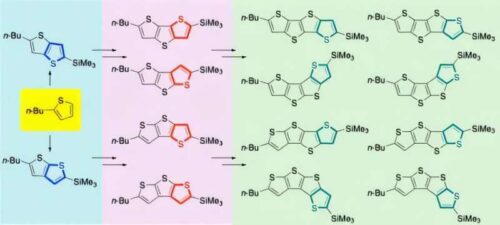
Saitama University researchers have developed a new molecular synthesis strategy that enables precise construction of ladder-type oligothiophenes, while the findings, published in Organic Letters, could support the design of improved organic semiconductors, flexible electronic devices and molecular materials.
Ladder-type oligothiophenes are sulphur-containing, π-conjugated molecules valued for their rigid fused-ring structures, which promote efficient electronic interactions. They are considered promising building blocks for organic field-effect transistors, flexible electronics and other semiconductor technologies. However, controlling the orientation of thiophene rings within these structures has remained a major challenge, limiting researchers’ ability to tailor their electronic properties.
Led by Associate Professor Hidenori Kinoshita, the research team developed a sequential annulation strategy that provides precise control over how new thiophene rings are added to existing molecular frameworks. The method combines halogenation, halogen-dance reactions, Sonogashira coupling and carbon-sulphur bond-forming cyclisation to produce structurally defined ladder-type molecules that are difficult or impossible to obtain using conventional synthetic approaches.
Using the technique, the researchers successfully synthesised all 14 target regioisomeric ladder-type oligothiophenes based on thienothiophene, dithienothiophene and trithienothiophene frameworks. The approach allows scientists to systematically control both the fused molecular framework and the orientation of sulphur-containing rings, expanding the available design space for organic electronic materials.
According to the researchers, the ability to engineer these structural variations offers a versatile molecular platform for investigating how subtle architectural differences influence electronic behaviour, including charge transport, band gaps and molecular packing.
Although the study focuses on synthetic chemistry, the team believes the strategy could contribute to the rational design of next-generation organic semiconductors and other functional molecular materials. The method provides a systematic route to constructing precisely defined molecular architectures, potentially accelerating the development of higher-performance electronic materials for future flexible, lightweight and energy-efficient technologies.