Centralized vehicle computers can now stream graphics, camera feeds and infotainment content to displays over an open-standard link, reducing proprietary dependencies and display-side complexity.
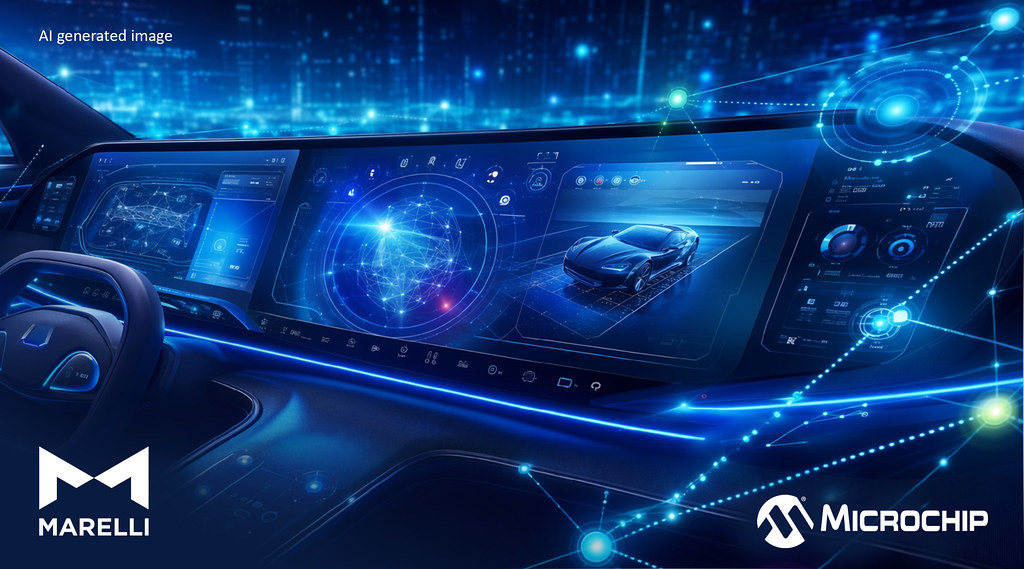
Microchip Technology and Marelli have developed an automotive display connectivity solution based on ASA Motion Link (ASA-ML), enabling graphics and video generated by centralized vehicle computers to reach automotive displays through a standardized high-speed connection.
At the core of the demonstrator is Microchip’s VS7000 ASA-ML chipset, which handles transmission of centrally generated video and graphics over the ASA-ML link. Marelli has integrated the display-side technology, configuring and optimizing the ASA-ML deserializer to decode the incoming standardized video stream directly at the display.
The approach targets software-defined vehicle (SDV) architectures, where computing functions are increasingly consolidated into centralized or zonal electronic systems. Instead of requiring dedicated processing hardware close to every display, content such as navigation maps, camera views, infotainment graphics and vehicle control interfaces can be generated centrally and transmitted to multiple displays.
ASA Motion Link is an open automotive SerDes standard developed by the Automotive SerDes Alliance (ASA). Its use can help vehicle manufacturers reduce dependence on proprietary connectivity technologies while allowing components from different suppliers to work within the same display architecture.
The key features are:
- 16 Gbps maximum link speed
- ASA-ML open-standard connectivity
- Link-layer authentication and encryption
- Lossless transmission with EMI immunity
- TDD and simplified FEC architecture
The solution supports data rates of up to 16 Gbps, providing bandwidth for high-resolution automotive display applications. Security features include link-layer authentication and encryption, while lossless communication and resistance to electromagnetic interference are intended to maintain reliable transmission inside vehicles.
The architecture also incorporates Time Division Duplex (TDD) and simplified Forward Error Correction (FEC), helping improve link efficiency and potentially reduce power requirements. Its standardized approach can give automakers greater flexibility when selecting display, connectivity and computing components from different suppliers.
Beyond cockpit displays, the technology can support applications requiring centrally generated visual information to be distributed across the vehicle. These include digital instrument clusters, infotainment screens, passenger displays, camera visualization and vehicle-interface screens.
The collaboration also points toward more Ethernet-centric vehicle architectures. By separating centralized computing from display-side processing and using an interoperable connectivity layer, automakers can develop display systems that are easier to scale across different vehicle platforms.