AI networks are under pressure. Can new optical chips cut power and speed up data? How do they work, and what changes for large systems?
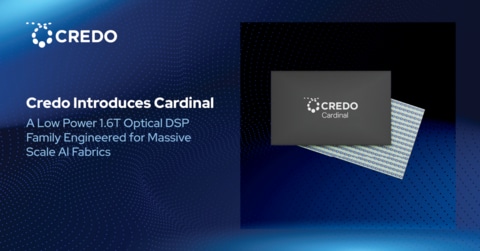
Credo Technology Group Holding Ltd has introduced Cardinal, a new family of 3nm optical DSPs built to handle the growing bandwidth, latency, and reliability demands of AI compute networks.
At the core is the Cardinal 1.6T optical DSP family, designed for large AI clusters where scale and power efficiency are critical. It uses a low-power architecture to deliver low latency and supports both retimed 1.6T optics and more power-efficient linear-receive (LRO) designs.
The launch reflects increasing pressure on network infrastructure from AI workloads. High-radix switches, dense GPU setups, and heavy east-west traffic require optics that can deliver high bandwidth per watt, low bit error rates, and strong monitoring. Cardinal targets these needs with support for 1.6T transceivers, a full link monitoring toolkit, and power consumption below 15W in LRO mode.
This is Credo’s second-generation 1.6T optical DSP lineup. It includes integrated EML and silicon photonics drivers with high swing, along with separate DSPs tailored for both full-retimed and LRO optical modules.
“AI fabrics have shifted the center of gravity for optical design, and Cardinal was developed from day one with those unique requirements in mind,” said Chris Collins, AVP of Sales & Optical Product Marketing at Credo. “By combining a proven low‑power architecture, superior latency with the flexibility to support both retimed 1.6T optics, and ultra‑efficient linear‑receive implementations, Cardinal gives our customers the exact tools they need to scale their AI infrastructure.”
“Credo’s LRO solution in the Cardinal family will be a critical enabler for our teams to deliver ultra-low power optical solutions designed for rack-scale AI infrastructure,” said Jason Wildt, VP/GM, Photonics at Jabil. “The power savings and associated thermal benefits are exactly what is needed for high‑density GPU clusters. Cardinal’s LRO option will provide our customers a solution that allows them to pack more performance into their power footprint.”
Click here for the original announcement.