
As high-voltage GaN and SiC devices push switching speeds higher, engineers face tougher electromagnetic interference challenges. New optocoupler designs could provide stronger isolation, noise immunity and long-term reliability without adding complex external filtering.
Wide-bandgap semiconductors such as gallium nitride (GaN) and silicon carbide (SiC) are enabling faster, more efficient power-conversion systems. However, their rapid switching creates demanding electromagnetic interference (EMI) conditions, making reliable isolation between control electronics and high-voltage power stages increasingly important.
Traditional isolation approaches can struggle in these environments. Magnetic isolators are vulnerable to external magnetic fields, particularly around high-current EV buses and power inductors, potentially introducing unwanted jitter or false logic transitions during demanding operating conditions.
Capacitive isolators face a different set of limitations. Their thin dielectric barriers can deteriorate under prolonged high-voltage stress or fail during rapid common-mode voltage transitions. Engineers may therefore need additional filtering, shielding and other protection measures, increasing system complexity, cost and PCB area.
Optical isolation provides a stronger barrier.
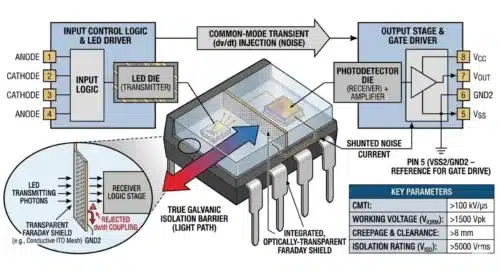
Optocouplers take a different approach by using light to transfer signals across the isolation barrier. Because photons are not affected by external magnetic fields, optical isolation can provide galvanic separation between the control circuitry and the noisy power stage.
Recent advances in optocoupler architecture have improved their ability to withstand the demanding transient conditions created by modern GaN and SiC switching. Specialised shielding and receiver technologies can provide high levels of common-mode transient immunity, helping to prevent unwanted output glitches during extremely fast switching events.
The physical separation inherent in optical packages also creates useful clearance and creepage distances. This can help designers meet demanding automotive and industrial safety requirements without relying on additional external shielding.
Reliability matters as switching speeds increase.
High EMI immunity is only part of the challenge. Wide-bandgap power systems must also maintain accurate timing and stable operation over many years.
Advanced optocouplers are designed to address propagation-delay variation while maintaining reliable isolation. Their characteristics can make them suitable for high-frequency switching applications where precise signal transmission is essential.
Long-term ageing is another consideration, particularly in harsh automotive and industrial environments. LED performance can gradually decline over time, reducing the available optical output. Newer designs incorporate measures intended to compensate for this degradation and maintain stable operation throughout an extended service life.
For designers working with high-voltage GaN and SiC systems, the combination of strong galvanic isolation, high common-mode transient immunity, precise signal transmission and long-term stability makes modern optocouplers an increasingly attractive option for demanding power-conversion applications.