

A Penn State team has improved perovskite thin films, helping indoor photovoltaics capture light efficiently while improving stability under intense illumination for longer-lasting everyday electronics.
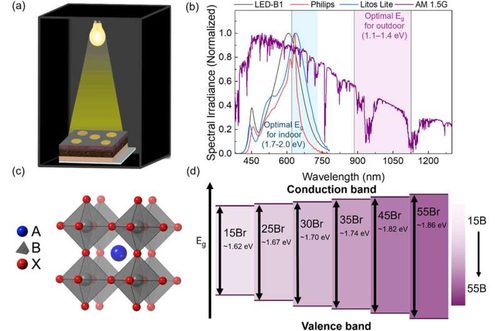
A Penn State team has developed improved perovskite thin films for indoor photovoltaics, with measurements covering LED-B1 and lighting spectra associated with Philips and LiteOn. The work aims to make small electronic devices less dependent on batteries or mains power by converting ambient indoor light into electricity.
The key advance is tuning the perovskite to better match the narrower spectrum produced by indoor lighting. Researchers adjusted the material’s bromine-to-iodide ratio across six compositions, gradually shifting its light absorption towards wavelengths available indoors. The composition containing 35% bromine delivered the strongest results in this study.
The team also focused on producing a better-quality thin film. Instead of commonly used chlorobenzene, researchers used dichlorobenzene as an antisolvent during fabrication. This helped encourage compact grains with fewer voids and better alignment, improving the film structure needed for photovoltaic performance.
Durability was addressed by adding phenethylammonium bromide, or PEABr, to the top of the perovskite layer. The salt forms a passivation layer that protects the surface from defects and slows degradation when the device is exposed to bright light for extended periods.
Testing showed no decline in device performance during 240 hours under high light intensities. The researchers estimate that the device could remain stable for thousands of hours. Its performance was maintained at light intensities around 10 to 50 times higher than those required by a new consensus framework, equivalent to roughly 8% to 50% of sunlight.
The approach could eventually support battery-free consumer electronics such as smart thermostats, wearable medical devices and TV remotes. However, durability and accurate performance measurement remain important challenges before indoor photovoltaics become widely practical.