




Tiny swarms could link phones directly to space
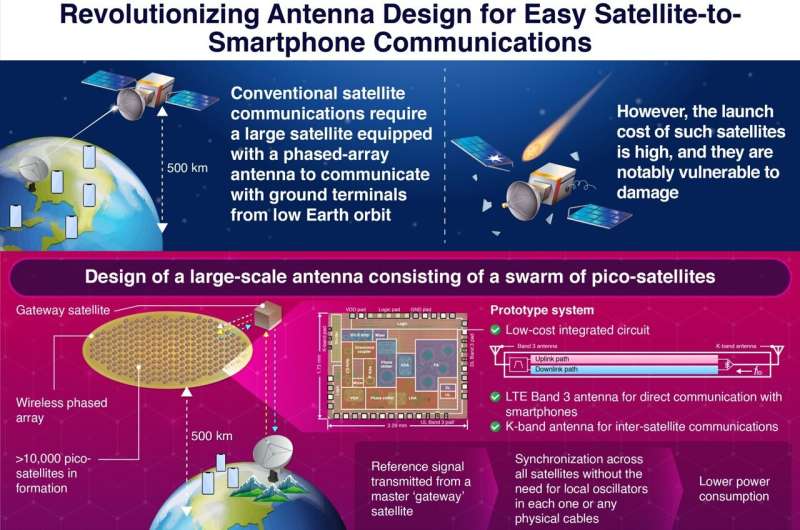
A new satellite architecture using thousands of pico-satellites could redefine how smartphones connect beyond terrestrial networks, potentially enabling direct-to-device (D2D) communication from space.
Researchers in the Institute of Science, Tokyo, Japan, have proposed a system where swarms of ultra-small satellites operate collectively as a single, large antenna. Instead of relying on one expensive, high-power satellite, the approach distributes antenna elements across thousands of pico-satellites flying in coordinated formation.
The concept targets a long-standing challenge in satellite communications: delivering reliable connectivity to standard smartphones without requiring specialised hardware. D2D satellite links are gaining traction globally as telecom and space companies look to extend coverage to remote regions, oceans, and disaster-hit areas where terrestrial networks fail.
In the proposed model, each pico-satellite carries a small हिस्सा of a phased-array antenna. These satellites are wirelessly synchronised, effectively behaving as a unified system capable of transmitting and receiving signals to and from Earth-based mobile devices.

The distributed design offers key advantages. It reduces dependency on large, complex satellites, lowers deployment risks, and improves scalability. If one unit fails, the system can continue functioning—unlike traditional single-satellite architectures.
This aligns with broader industry momentum toward satellite miniaturisation and constellation-based networks. Small satellites are already valued for lower costs, faster deployment, and flexibility in communications and Earth observation applications.
However, significant technical challenges remain. Maintaining precise synchronisation across thousands of fast-moving satellites, ensuring signal coherence, and managing orbital coordination are complex engineering hurdles that must be solved before real-world deployment.
Still, the research points to a future where smartphones could seamlessly connect to space-based networks, complementing terrestrial infrastructure. As satellite constellations expand and telecom standards evolve, pico-satellite swarms may become a critical layer in next-generation global connectivity.


