

A power converter supplies power to space electronics, helping processors and digital devices operate under radiation and temperature changes.
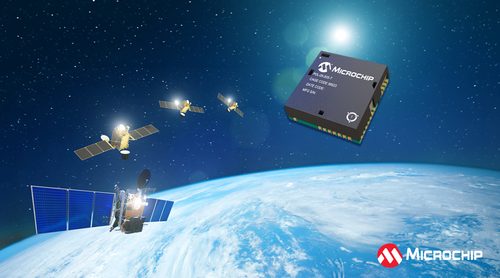
Microchip Technology has introduced the POL-05-20S-T, a radiation-tolerant point-of-load (POL) converter designed to meet the power requirements of space processing systems. It uses gallium nitride (GaN) power devices to deliver up to 20A of output current with high efficiency and power density.
The converter comes in a 25g surface-mount package measuring 1.51 × 1.51 × 0.45 inches. Its ability to deliver 20A within this footprint helps engineers manage size, power and energy constraints in onboard processing systems. The GaN-based design combines high efficiency, power density and continuous current delivery for space power applications.
The POL-05-20S-T is designed to power FPGAs, microcontrollers, application-specific integrated circuits (ASICs) and other digital devices that require high current and respond quickly to changes in power demand. It uses a synchronous buck converter with current-mode control to manage rapid current changes and maintain stable operation. The device supports an input voltage of 4.75V to 13.2V and an adjustable output voltage of 0.7V to 5V, allowing it to support different power rails and system designs.
For use in radiation-exposed space environments, the converter’s electrical parameters are specified before and after exposure to a total ionising dose (TID) of up to 50 krad. It is also characterised for single-event effects (SEE) at a linear energy transfer (LET) of up to 43 MeV·cm²/mg. The device operates at full load across temperatures from −55°C to +100°C, supporting systems exposed to wide temperature variations during missions.
The converter includes remote sensing, undervoltage and overvoltage protection, soft start, an enable pin and a power-good indication pin. Its adjustable output voltage, wide input range and output droop regulation allow engineers to configure power delivery for high-current loads that require voltage regulation and a fast response to changes in demand.
The company’s space power portfolio includes electromagnetic interference (EMI) filters, DC-DC converters, point-of-load regulators, high-reliability discrete components, FPGAs and PIC64-HPSC high-performance spaceflight computing devices. These components and devices form part of an end-to-end offering intended to help space system designers simplify development, reduce design risks and accelerate the deployment of mission-critical systems.
Click here for the original announcement.