What if heat could travel like light instead of spreading out? Researchers have now observed this behaviour at room temperature.
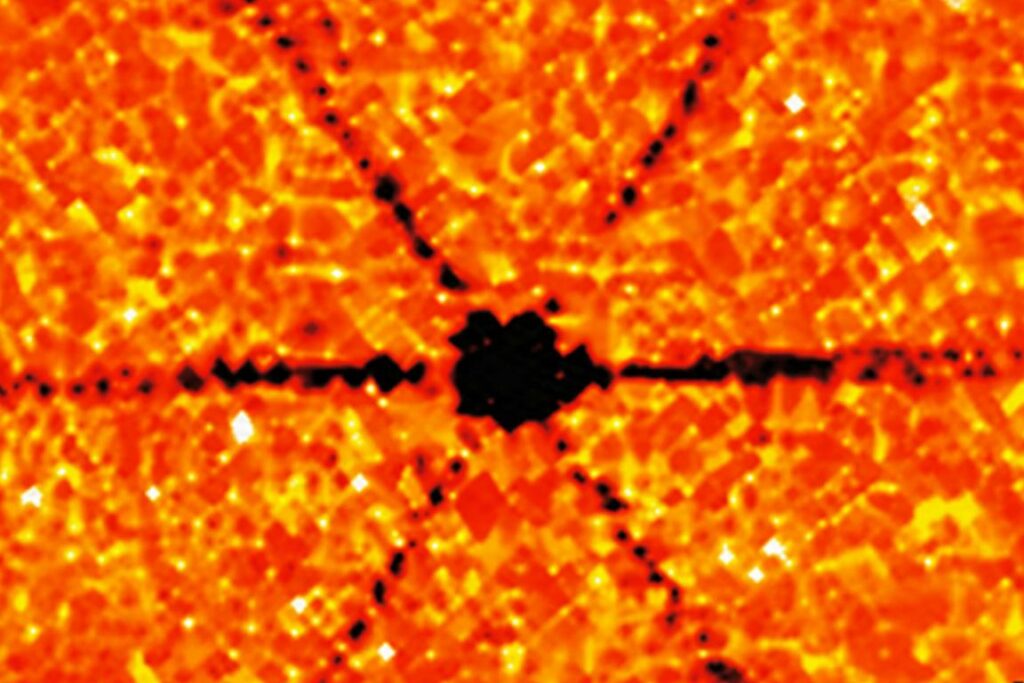
Researchers at the UCLA Samueli School of Engineering have demonstrated that phonons, the quantum-mechanical vibrations that carry heat through solids, can travel in focused, ray-like paths at room temperature. The observation was made in boron arsenide, a crystalline semiconductor known for its high thermal conductivity.
The finding could offer a different approach to thermal management in electronics. Instead of allowing heat to spread and then removing it, engineers could potentially guide heat towards specific locations or away from temperature-sensitive components.
This could be particularly relevant to AI hardware, microelectronics, photonic systems, and quantum technologies, where increasing power densities make heat dissipation a growing design constraint. The ability to control heat propagation could also provide a way to manage interactions between phonons, electrons, and other energy carriers.
The researchers developed a nanoscale temperature-mapping technique to observe the heat-flow behaviour. In conventional materials, the measurements produced circular patterns associated with diffusive heat conduction. In boron arsenide, the team instead observed distinct ray-like patterns aligned with specific directions of the crystal lattice.
The researchers found that changing the crystal orientation altered the pattern, producing sixfold, eightfold, or fourfold focusing depending on the crystal plane. The focused phonon behaviour persisted over distances of about one micrometre and could potentially extend to tens of micrometres.
The observation is significant because phonon focusing had previously been demonstrated mainly at cryogenic temperatures, where reduced scattering allows phonons to retain wave-like behaviour over longer distances. Boron arsenide’s unusually weak phonon scattering allows this behaviour to persist at room temperature.
“This is a fundamental observation that enables us to think about thermal management in a new way,” says Yongjie Hu, professor of mechanical and aerospace engineering at the UCLA Samueli School of Engineering, “By enabling heat to be guided, focused and redistributed with nanoscale precision at room temperature, the discovery establishes a foundation for quantum thermal engineering.”